Glossary
Spec & terminology reference — materials, hardware, netting, standards, and trade terms in plain English
The words on the
spec sheet, defined
59 terms from across our fishing, marine-hardware, and sports-netting lines — the materials, coatings, load ratings, net constructions, standards, and trade terms a buyer meets when reading a quote or a spec sheet. Written plainly, and cross-linked to the guides and products that cover each one in depth.
Materials & Coatings
Coatings, alloys, and foams — what protects the steel and keeps gear afloat.
- Hot-Dip Galvanizing
-
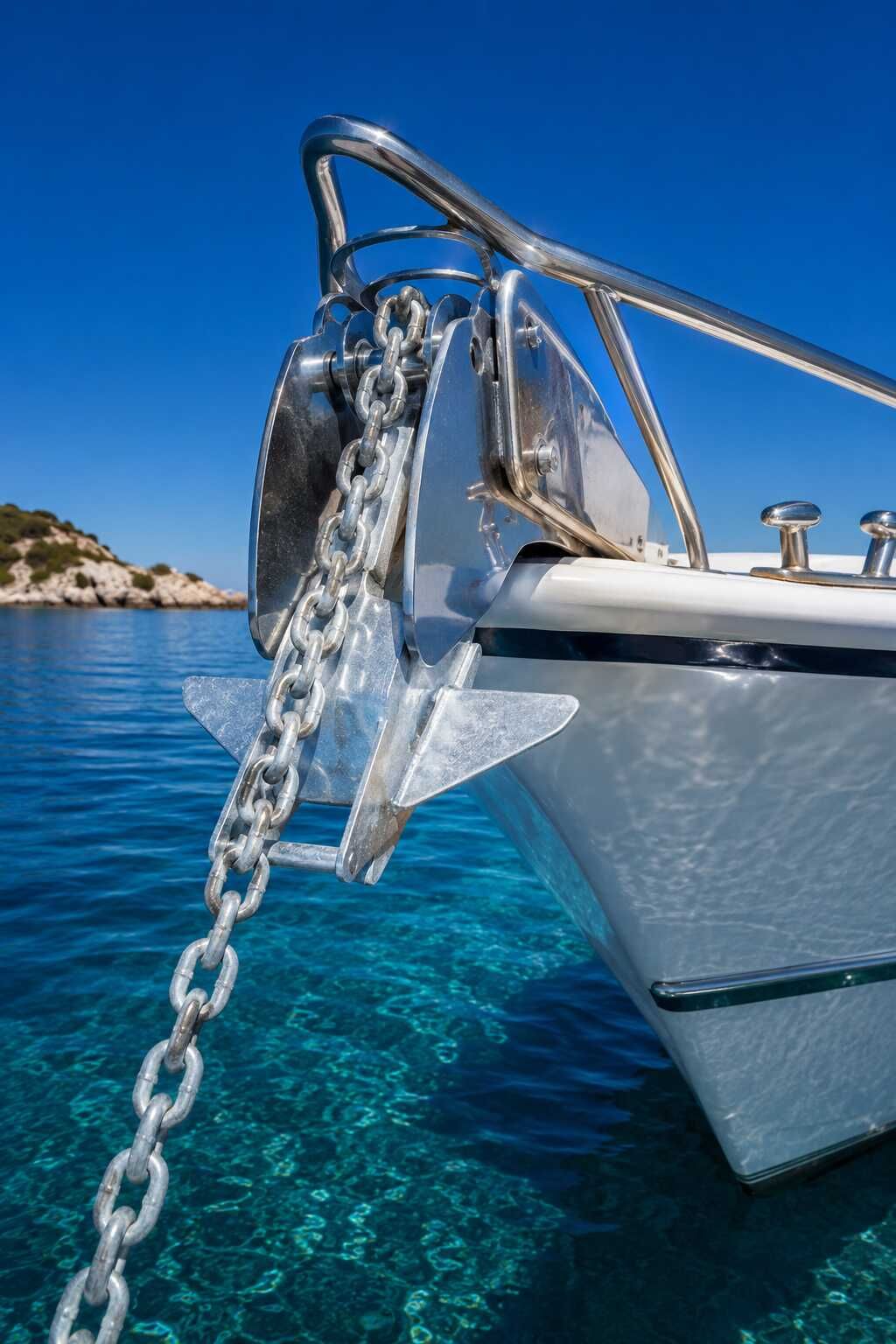
A corrosion-resistant finish made by immersing finished steel parts in a bath of molten zinc. The bonded zinc layer is sacrificial — it corrodes in preference to the steel beneath, so the coating keeps protecting the base metal even where it is scratched or cut. It is the standard finish for anchors, chain, and shackles in saltwater service.
- Electro-Galvanizing
-
A thinner zinc coating applied to steel electrically (electroplating) rather than by hot dipping. It gives a smoother, brighter finish at lower cost, but the thinner zinc layer offers less corrosion protection than hot-dip galvanizing, so it suits lighter-duty or sheltered use.
- 316 Stainless Steel
-
A marine-grade stainless alloy containing molybdenum, which improves resistance to chloride (saltwater) pitting compared with 304. It is chosen for permanently immersed or high-visibility marine hardware where the longest corrosion life and a polished appearance are required.
- 304 Stainless Steel
-
A general-purpose stainless alloy with good corrosion resistance in fresh water and mild environments, but more prone to pitting in salt water than 316. Often specified where appearance matters and saltwater exposure is occasional rather than continuous.
- PVC / Vinyl Coating
-
A polymer coating bonded over galvanized steel wire to add a second barrier against corrosion and abrasion. Common on crab and lobster traps and fishing baskets, it protects the wire through repeated saltwater immersion and is gentler on the catch.
- Powder Coating
-
A dry finish applied as electrostatically charged powder, then cured under heat into a hard, even film. It gives steel frames such as goals and cages an attractive, abrasion-resistant color finish, though it protects only as long as the film stays unbroken.
- Anodizing
-
An electrochemical process that thickens the natural oxide layer on aluminum, hardening the surface and improving corrosion and wear resistance. Used on aluminum sports frames and uprights as a durable alternative to paint.
- Closed-Cell Foam (EVA / PVC)
-
Foam whose gas cells are sealed from one another, so it will not absorb water or sink even if the outer skin is punctured. Floats and buoys are molded from closed-cell EVA/PVC foam, unlike hollow floats that flood once breached.
- UV Stabilization
-
Additives blended into plastics and netting that slow degradation from sunlight (ultraviolet) exposure. UV-stabilized netting and floats keep their strength and color through multiple outdoor seasons rather than going brittle and faded.
- Drop Forging
-
A process that shapes heated steel by hammering it into a die under high force. The continuous grain flow it produces makes drop-forged shackles, swivels, and turnbuckles stronger and more consistent than cast or fabricated equivalents.
- Cathodic Protection (Sacrificial Anode)
-
A corrosion-control method in which a more reactive metal — typically a zinc anode — is bonded to a steel structure so it corrodes first, protecting the steel it is attached to. Zinc anodes are fitted to traps and marine gear for this purpose.
Marine Hardware & Rigging
Load ratings, chain grades, anchors, and the fittings that connect them.
- Working Load Limit (WLL)
-
The maximum load a piece of rigging hardware is rated to carry in normal service, marked permanently on shackles, swivels, and chain. It sits well below the breaking strength — the gap between them is the safety factor — and must never be exceeded.
- Proof Load (Proof Test)
-
A test load — commonly twice the rated working load — applied to a piece to verify it carries that load without permanent deformation before it ships. Everwin anchors, shackles, and swivels can be individually proof-tested to 2× WLL.
- Breaking Strength (MBL)
-
The load at which a component actually fails, also called minimum breaking load. The working load limit is derived from it by dividing by a safety factor, so breaking strength is always several times higher than the rated WLL.
- Safety Factor
-
The ratio between a component's breaking strength and its working load limit (for example 4:1 or 5:1). It provides a margin for shock loads, wear, and material variation, and is set by the governing standard for each type of hardware.
- Grade 30 Chain (Proof Coil)
-
A general-purpose carbon-steel chain, also called proof coil, suited to anchor rode and utility marine use. It is the lower-strength of the common marine grades and is chosen where Grade 43's higher working load is not required.
- Grade 43 Chain (High-Test)
-
A higher-strength carbon-steel chain, also called high-test, offering a greater working load than Grade 30 at the same diameter. It is favored for anchor rode where weight savings or higher holding capacity matter.
- Short-Link / BBB Chain
-
Chain with shorter, thicker links (designated BBB) whose uniform pitch suits windlass and gypsy use. The closely spaced links mate with the wheel of an anchor windlass for reliable feeding.
- Calibrated Chain
-
Chain manufactured to a tightly controlled link length and width so it engages accurately with a windlass gypsy. Using non-calibrated chain on a windlass risks slipping or jamming as the wheel turns.
- Anchor Rode
-
The complete connection between boat and anchor — chain, rope, or a combination — together with the shackles and swivel that join them. Its length and weight govern how well the anchor sets and holds.
- Scope (Ratio)
-
The ratio of deployed rode length to water depth measured from the bow, such as 5:1 or 7:1. Greater scope lowers the angle of pull at the anchor, letting it dig in and hold; too little scope is the most common cause of dragging.
- Holding Power
-
The force an anchor can resist before it drags, set by its design, weight, and how well its flukes penetrate the seabed. Matching holding power to vessel size and bottom type is the core of anchor selection.
- Danforth (Fluke) Anchor
-
A lightweight anchor with two long, flat pivoting flukes that bury deep in sand or mud, giving high holding power for its weight. It stows flat but holds poorly in rock or heavy weed.
- Plow Anchor
-
A single-point anchor shaped like a plowshare (Delta or CQR-style) that tends to reset itself when wind or tide shifts the direction of pull. A versatile all-bottom choice popular for cruising boats.
- Mushroom Anchor
-
A bowl-shaped anchor that holds by sinking into soft mud and silt, best suited to permanent moorings rather than temporary anchoring. Its holding power builds as it beds in over time.
- Grapnel Anchor
-
A folding anchor with several hooked tines, used for small boats, kayaks, and rocky bottoms where the tines can grab structure. Compact to stow, but limited in holding power on soft ground.
- Shackle Types (Bow vs. Dee)
-
A shackle is a U-shaped connector closed by a pin. The bow (or omega) shackle has a rounded body that takes loads from several directions; the dee (D-type) is narrower and strongest in a straight-line pull. Pins are either screw-in or a bolt/nut/cotter set for permanent installations.
- Swivel
-
A rigging fitting with a rotating joint that lets one end turn freely under load, preventing twist from building up in anchor rode, tow lines, and rigging. Made in jaw-jaw, eye-eye, and jaw-eye end combinations.
- Take-Up (Turnbuckle)
-
The total adjustment range of a turnbuckle — how far the end fittings draw together as the body is turned — used to tension standing rigging, guy wires, and structural cables. Quoted as the travel between fully open and fully closed.
- Windlass (Gypsy)
-
A deck winch that hauls and stows anchor chain, with a toothed wheel (the gypsy) shaped to grip a specific chain pitch. It requires calibrated or correctly pitched chain to feed without slipping.
Netting & Cordage
Net construction, fibers, and the cordage terms behind every net spec.
- Knotted Netting
-
Net made by tying each mesh intersection with a knot, producing a strong, repairable panel that holds its shape under heavy or uneven loads. Preferred for batting cages and high-impact barrier nets; the knots add weight and bulk.
- Knotless Netting
-
Net whose strands are interwoven or fused rather than knotted, giving a lighter, smoother, snag-resistant panel with no knots to abrade a ball or fish. Common on volleyball, soccer, and golf nets.
- HDPE (High-Density Polyethylene)
-
A light, low-cost synthetic fiber with excellent UV and water resistance but lower stretch and abrasion resistance than nylon. Widely used for knotless sports and barrier netting that lives outdoors.
- Nylon (Polyamide)
-
A strong, abrasion- and impact-resistant fiber with good elasticity that absorbs shock loads well, which is why knotted nylon is favored for batting cages. It takes up some water and is more UV-sensitive than polyester or HDPE unless treated.
- Polyester
-
A synthetic fiber with high tenacity, low stretch, and strong UV and weather resistance, holding tension and shape over long outdoor exposure. Used for tennis, golf, and long-span barrier netting.
- High-Tenacity Yarn
-
Yarn spun for above-average strength-to-weight, letting a net reach a given strength with thinner, lighter strands. High-tenacity polyester is specified where a taut, durable net must stay light.
- Net Twine Number (#36, #42)
-
A numbering scale for knotted-net twine thickness in which a higher number means a heavier, stronger strand. Batting cages, for example, use #36 for general use and heavier #42 for high-volume training.
- Cord Diameter
-
The thickness of a net's strand, given in millimeters (such as 4 mm or 5 mm) for knotless sports nets. A larger diameter adds strength and durability at the cost of weight, so high-use goals specify the heavier cord.
- Mesh Size (Opening)
-
The dimension of a single net opening, measured across the square. It is matched to the ball or target species — small enough to contain it, large enough to limit the net's weight and wind load.
- Aircraft Cable
-
A flexible, high-strength stranded steel cable, usually vinyl-coated for corrosion resistance, run through the top of a net to carry the headline tension. Used on volleyball and tennis net headlines.
Fishing Gear
Trap, basket, and float terms specific to commercial fishing gear.
- Escape Panel (Biodegradable)
-
A section of a trap fastened with a biodegradable or corrodible link required by many fisheries. If a trap is lost, the panel eventually fails and opens, releasing trapped animals to prevent ongoing ghost fishing.
- Ghost Fishing
-
The continued, unintended capture of marine animals by traps or nets that have been lost or abandoned. Biodegradable escape panels and escape rings are the standard mitigation built into compliant traps.
- Buoyancy (Rating)
-
The upward force a float provides, rated in pounds — the load it can hold at the surface before submerging. Floats and buoys are selected so their buoyancy supports the gear and line they mark or suspend.
- Wire Gauge
-
A numbering system for wire thickness in which a lower number is a thicker, stronger wire. Trap and basket wire is specified by gauge (for example 11- or 12-gauge) to balance strength, weight, and cost.
Standards & Testing
The test specifications and governing bodies referenced across the catalog.
- ASTM
-
ASTM International publishes consensus material and product standards used worldwide. Everwin marine chain, shackles, turnbuckles, and movable soccer goals reference ASTM specifications (such as A413, F1145, and F2950) where applicable.
- EN (European Norm)
-
Harmonized standards issued by the European Committee for Standardization, often required for goods sold in Europe. Marine shackles, for example, can be built to EN 13889.
- NACM
-
The National Association of Chain Manufacturers publishes the dimensional and strength specifications that define North American welded-chain grades such as Grade 30 and Grade 43.
- Governing-Body Play Standards (FIFA, NCAA, NFHS, ITF, FIVB)
-
The sport federations and associations that set official dimensions for goals, courts, and nets. Everwin nets and goals are produced to these dimensions — FIFA/NCAA/NFHS for soccer, ITF/USTA for tennis, FIVB/USAV for volleyball — so equipment meets play requirements.
Sourcing & Trade Terms
How custom orders, minimums, and international shipping terms work.
- MOQ (Minimum Order Quantity)
-
The smallest quantity a factory will produce for an order. Standard catalog items ship by the carton toward container volume, while custom or private-label runs generally start at about 500 units per specification.
- OEM (Original Equipment Manufacturer)
-
Manufacturing a product to a buyer's design and specification, often for sale under the buyer's own brand. Everwin produces OEM traps, hardware, and nets to customer drawings, dimensions, finishes, and markings.
- Private Label
-
Producing standard or lightly customized goods carrying the buyer's brand, packaging, and markings rather than the factory's. A faster route to a branded line than full custom OEM tooling.
- Tooling
-
The dies, molds, and fixtures made to produce a custom part. Tooling is a one-time upfront cost amortized over the order, which is part of why custom programs carry a minimum quantity.
- Sampling
-
Producing and approving a pre-production sample before the full run to confirm dimensions, finish, and branding. First-time custom orders include a sampling stage, which is why their lead time runs longer than repeat orders.
- Lead Time
-
The time from confirmed order and deposit to goods ready to ship. Standard items typically run 30–45 days; first custom or OEM runs, including sampling, usually 45–60 days, with repeat orders back to 30–45.
- Incoterms
-
A set of standardized international trade terms, published by the ICC, that define exactly where the seller's responsibility for cost and risk ends and the buyer's begins. Agreeing the Incoterm up front makes competing quotes directly comparable.
- FOB (Free On Board)
-
An Incoterm under which the seller delivers the goods, cleared for export, onto the vessel at the named port; risk and the onward sea freight, insurance, and import costs pass to the buyer there. The workhorse term for ocean freight and the cleanest basis for comparing quotes.
- CIF (Cost, Insurance & Freight)
-
An Incoterm under which the seller pays the cost, sea freight, and minimum marine insurance to the named destination port — though risk still passes to the buyer once the goods are aboard. Convenient when you want the seller to arrange main carriage.
- DDP (Delivered Duty Paid)
-
An Incoterm under which the seller delivers the goods to the buyer's door with all freight, insurance, import duties, and customs clearance paid — the maximum-service term, placing the most responsibility on the seller.
- EXW (Ex Works)
-
An Incoterm under which the seller only makes the goods available at the factory; the buyer arranges export clearance and everything onward. Maximum buyer control and responsibility — rarely ideal for a first-time importer.