Sports · 3 min read · Updated
When a facility, school, or league buys nets and goals, "regulation" is not marketing language — it's a set of governing-body dimensions and safety standards the equipment has to meet to be used in sanctioned play. Specify the wrong standard and the gear can't be used; specify the right one and procurement is straightforward.
Here's a plain-English map of the standards that matter for the most common sports, and how they shape what you order.
Why the standard matters before the price
Each sport's governing body publishes dimensional and safety requirements, and the level of play determines which set applies — international (FIFA, FIVB, ITF), US college (NCAA), or US high school (NFHS). The differences are usually small but real, so the first question on any net or goal order is which body and level of play the equipment must satisfy.
Soccer goals
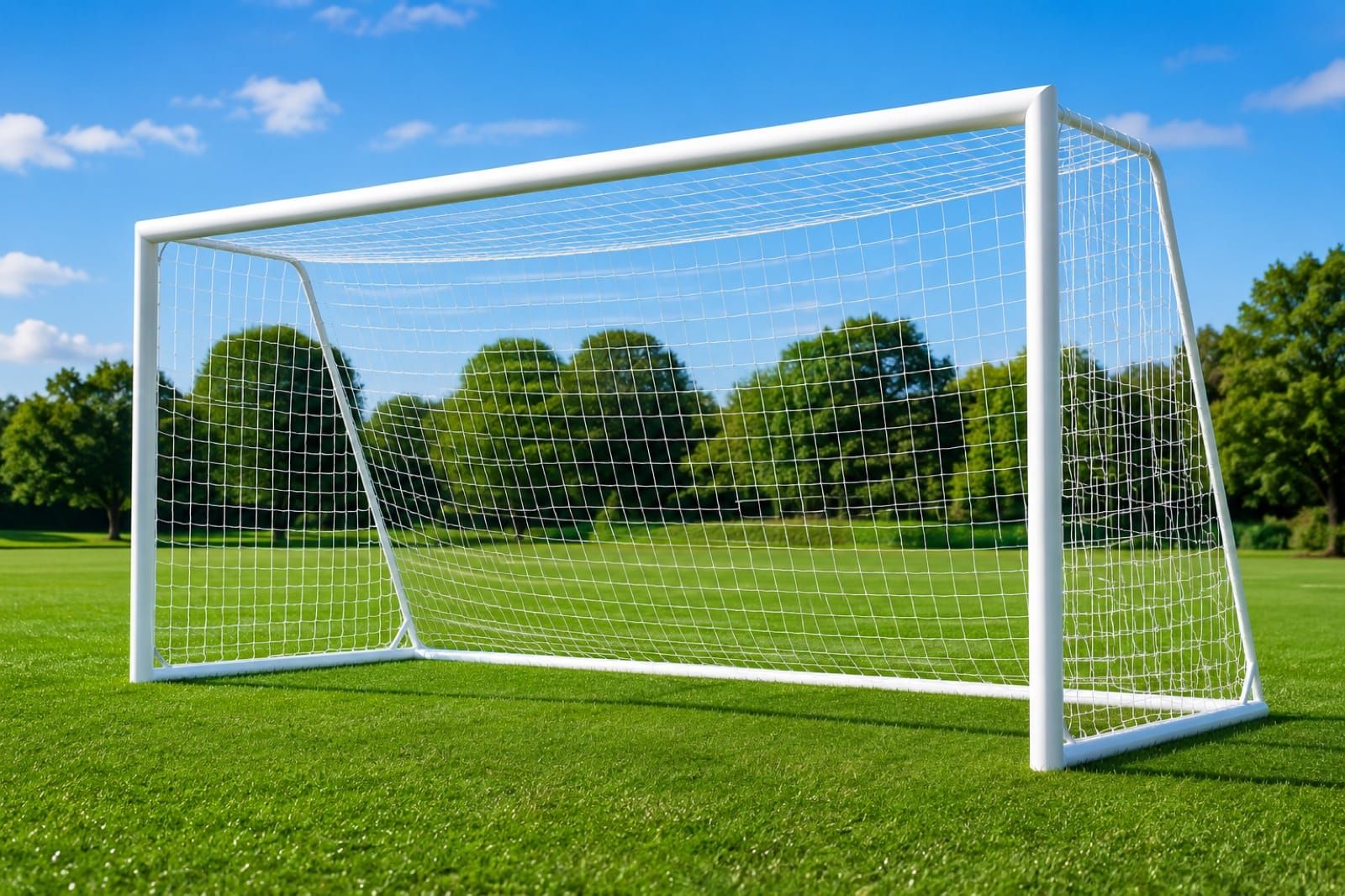
A full-size soccer goal is 24 feet wide by 8 feet high (7.32 m × 2.44 m) under FIFA's Laws of the Game, and NFHS and NCAA match those dimensions for 11-a-side play. Youth and small-sided formats use reduced sizes. Beyond dimensions, soccer goals carry a critical safety/performance standard: ASTM F2950 covers soccer-goal safety and performance, and anchoring should be specified for movable goals because un-anchored goals tipping over is a documented injury risk.
- Full size: 24 ft × 8 ft (7.32 m × 2.44 m) — FIFA / NFHS / NCAA
- Youth and small-sided formats use reduced goal sizes
- Soccer goals: specify ASTM F2950 safety/performance requirements and appropriate anchoring for movable goals
Volleyball and tennis nets
Net heights are fixed by governing body and division. Indoor volleyball net height is 2.43 m for men and 2.24 m for women under FIVB. Tennis nets are 3 feet 6 inches (1.07 m) at the posts and 3 feet (0.914 m) at the center strap under ITF rules. These are non-negotiable for sanctioned play, so the spec is the spec — what varies between suppliers is the net's material and build quality, not its height.
- Volleyball (FIVB): 2.43 m men / 2.24 m women, indoor
- Tennis (ITF): 3 ft 6 in at posts, 3 ft at center
Net material and construction
Where suppliers genuinely differ is the netting itself. HDPE, nylon (polyamide), and polyester each trade off strength, stretch, and weather resistance differently. Twine thickness (often given as denier or ply), knot type, and mesh size set durability and how the net plays. For any outdoor installation, UV treatment is essential — untreated netting embrittles and fails within a season or two of sun exposure.
- HDPE: strong, light, good outdoor weatherability
- Nylon: high strength and elasticity; absorbs more water
- Polyester: dimensionally stable, holds tension well
- Outdoor: UV-treated twine is non-negotiable for service life
Specifying for procurement
Put the governing body, level of play, and material spec in writing on the order — "FIFA/IFAB full-size, 24×8, ASTM F2950 goal, UV-treated HDPE net" leaves nothing to interpretation. For multi-sport facilities, a single supplier who can match the framing, the netting, and the anchoring to each sport's standard is simpler to procure and warranty than piecing it together.
- Governing body and level of play identified (FIFA/FIVB/ITF, NCAA, NFHS)
- Goal and net dimensions matched to that standard
- ASTM F2950 safety/performance requirements and anchoring specified for movable goals
- Net material chosen for the sport and environment (HDPE / nylon / polyester)
- UV-treated twine specified for all outdoor installations
- Twine thickness, knot type, and mesh size confirmed
Common questions
What is the regulation size of a full-size soccer goal?
A full-size soccer goal is 24 feet wide by 8 feet high (7.32 m x 2.44 m) under FIFA's Laws of the Game, and NFHS and NCAA match those dimensions for 11-a-side play. Youth and small-sided formats use reduced sizes.
What is the official height of a volleyball or tennis net?
Indoor volleyball net height is 2.43 m for men and 2.24 m for women under FIVB. Tennis nets are 3 feet 6 inches (1.07 m) at the posts and 3 feet (0.914 m) at the center strap under ITF rules. These heights are fixed for sanctioned play.
What is ASTM F2950 and do my goals need it?
ASTM F2950 is the active safety and performance specification for soccer goals. Any movable goal should also be specified with suitable anchoring, because un-anchored goals tipping over is a documented injury risk.
What is the difference between FIFA, NCAA, and NFHS standards?
They cover international, US college, and US high-school play respectively. For full-size soccer goals the dimensions align, but smaller requirements can differ by body and level. The first question on any net or goal order is which governing body and level of play the equipment must satisfy.
How should I write a net and goal spec for procurement?
Put the governing body, level of play, dimensions, anchoring, and net material in writing — for example, "FIFA/IFAB full-size, 24x8, ASTM F2950 goal, UV-treated HDPE net." That leaves nothing to interpretation. For multi-sport facilities, a single supplier who matches framing, netting, and anchoring per sport is simpler to procure and warranty.
Specification terms used in this guide — full definitions in the glossary .