Marine · 3 min read · Updated
There is no universal best anchor — only the right anchor for a given seabed and vessel. The same anchor that buries itself and holds firmly in sand can skate uselessly across rock or grass. Choosing well starts with the bottom you anchor in, not the brand on the box.
Here are the main anchor families, how each one holds, and where each earns its place. For matching the size and chain to your boat once you've picked a type, see our anchor and chain sizing guide.
Why the bottom drives the choice
An anchor holds by either digging into the seabed or, for moorings, by sheer weight. Which mechanism works depends entirely on the bottom: soft sand and mud reward anchors that bury deep; rock and weed reward anchors that hook or grab; permanent moorings in soft ground reward dead weight and suction. Pick the type for your typical bottom first, then size it to the vessel.
Fluke (Danforth) anchors
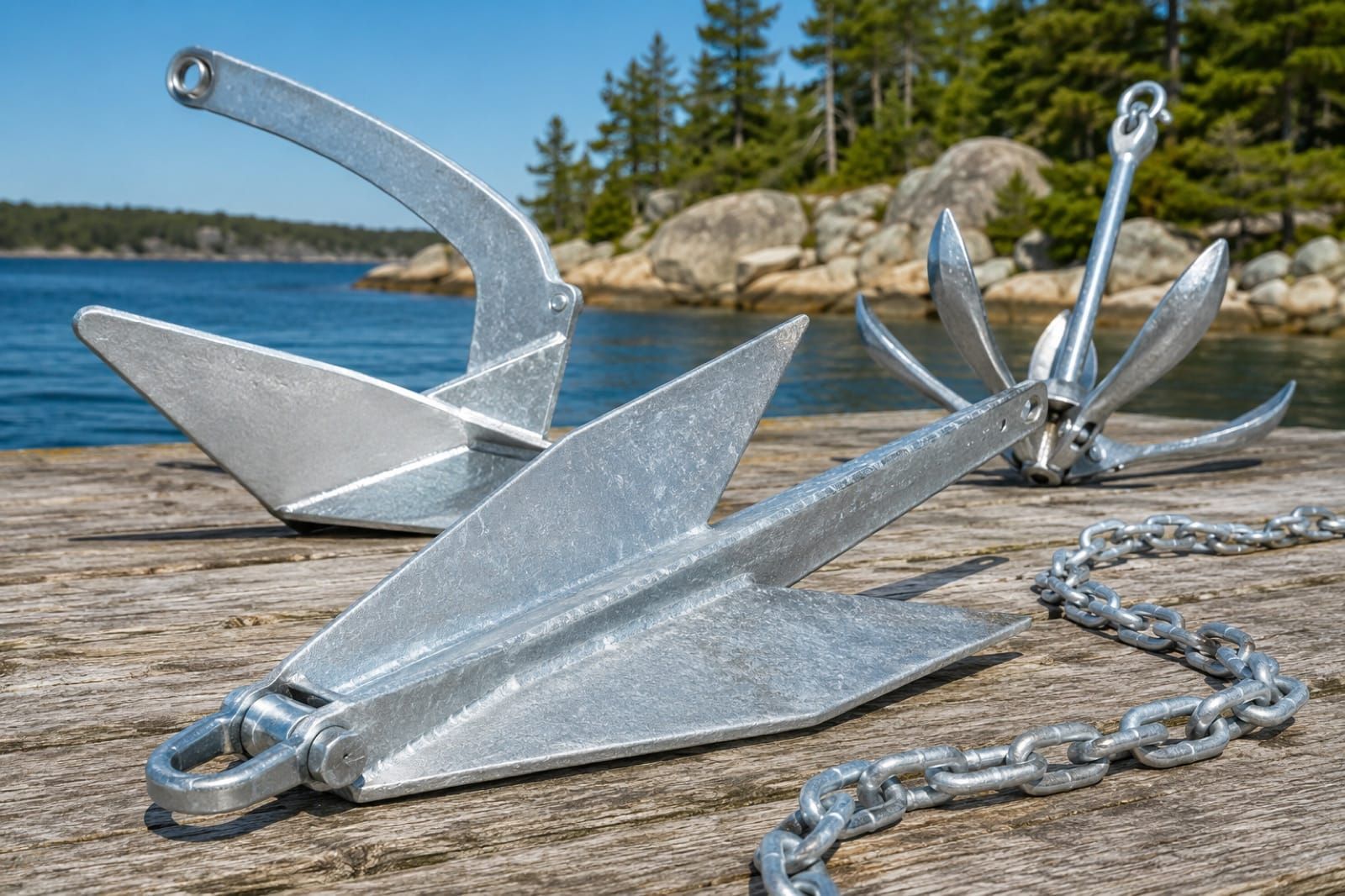
The fluke or Danforth-style anchor has two large, flat, pivoting flukes that dig in fast and deliver exceptional holding power for their weight in sand and soft mud. It stows flat, which makes it a popular primary or secondary anchor on smaller boats. The trade-offs: it struggles to set in rock, grass, or hard bottoms, and it can break out and need to re-set if the wind or current swings the boat through a large angle.
- Best bottoms: sand, soft mud
- Very high holding-power-to-weight ratio; stows flat
- Trade-off: poor in rock and weed; can break out on big tide or wind shifts
Plow and claw anchors
Plow-type anchors (CQR and Delta styles) and claw anchors (Bruce style) trade some peak holding for versatility and reliable resetting. A plow digs in like its namesake and resets well when the boat swings, making it a trusted all-round bow anchor across mixed bottoms. The claw sets easily and holds steadily in a wide range of conditions, including some rock and grass, though it gives up holding power per pound to the fluke and plow. Both are favorites on cruising boats that anchor in varied ground.
- Best bottoms: mixed — sand, mud, some rock and weed
- Plow (CQR / Delta): strong all-rounder, resets well on swings
- Claw (Bruce): sets easily, forgiving, steady hold
- Trade-off: lower holding per pound than a fluke in clean sand
Mushroom and deadweight anchors (moorings)
For permanent moorings rather than day anchoring, holding comes from weight and suction, not a bite. A mushroom anchor settles into soft mud and silt, where it gradually buries and develops strong suction-based hold — ideal for a long-term mooring in a sheltered, soft-bottomed harbor. Deadweight anchors (concrete or cast blocks) hold by mass alone and work on almost any bottom, including hard ground where a mushroom can't bury. Both are sized far heavier than a comparable day anchor because they rely on weight.
- Best use: permanent moorings, not day anchoring
- Mushroom: buries and develops suction in soft mud and silt
- Deadweight: holds by mass; works on hard bottoms too
- Sized much heavier than a day anchor of equivalent holding
Grapnel, specialty types and how to choose
The grapnel — a shank with several hooked arms — is built to grab rock, coral edges, and wreckage rather than bury, and folds compact for small craft, kayaks, and as a secondary. It holds poorly in sand or mud, so it is a specialist, not an all-rounder. To choose overall: match the type to your usual bottom (fluke for sand, plow or claw for mixed cruising, mushroom or deadweight for moorings, grapnel for rock), then size to the vessel's displacement and windage and pair it with correctly rated chain and connectors. Many boats carry two complementary types for the bottoms they actually see.
- Primary anchor type matched to your usual seabed
- Fluke for sand and mud; plow or claw for mixed cruising grounds
- Mushroom or deadweight specified for permanent moorings
- A second, complementary anchor for off-bottoms you encounter
- Type sized to vessel displacement and windage (see sizing guide)
- Chain and connectors rated and finish-matched to the anchor
Common questions
Which anchor type is best for a sandy bottom?
A fluke (Danforth-style) anchor. Its two large, flat, pivoting flukes dig in fast and deliver exceptional holding power for their weight in sand and soft mud, and it stows flat. The trade-off is that it struggles to set in rock or grass and can break out if the boat swings through a large angle.
What anchor works best for mixed or rocky bottoms?
For mixed cruising grounds, plow anchors (CQR/Delta) and claw anchors (Bruce) trade some peak holding for versatility and reliable resetting across sand, mud, and some rock and weed. For rock, coral edges, or wreckage specifically, a grapnel is built to grab rather than bury — but it holds poorly in sand or mud.
What kind of anchor is used for a permanent mooring?
Mushroom and deadweight anchors. A mushroom buries and develops suction in soft mud and silt, ideal for a sheltered, soft-bottomed harbor; a deadweight (concrete or cast block) holds by mass and works on almost any bottom, including hard ground. Both are sized far heavier than a comparable day anchor because they rely on weight.
Why doesn't one anchor work for every seabed?
An anchor holds by digging into the seabed or, for moorings, by sheer weight — and which mechanism works depends entirely on the bottom. Soft sand and mud reward anchors that bury; rock and weed reward anchors that hook or grab; soft-ground moorings reward dead weight and suction. Pick the type for your typical bottom first, then size it to the vessel.
Should I carry more than one anchor?
Many boats do. A second, complementary anchor covers the off-bottoms you occasionally encounter and serves as a storm or backup anchor. Match each type to the bottoms you actually see, then size to displacement and windage and pair with correctly rated, finish-matched chain and connectors.
Specification terms used in this guide — full definitions in the glossary .