Netting · 3 min read · Updated
Every net is one of two constructions. In knotted netting the twine is tied at each mesh intersection. In knotless netting the strands are knitted, braided or twisted through each other at the intersection, with no knot.
Neither is the better net in general. Each has a set of applications where it is the standard choice, and the reasons are mechanical: where the mesh breaks, how much it weighs, what it does to whatever touches it, and how it is repaired.
Side-by-side comparison
The table compares the two constructions at the same twine material and a similar twine size.
| Property | Knotted netting | Knotless netting |
|---|---|---|
| How the mesh is formed | Twine tied at each intersection | Strands knitted, braided or twisted through each other |
| Where it breaks | At the knot, below straight-twine strength | Along the strand or at the joint; no knot to weaken it |
| Weight for a given mesh strength | Heavier — knots use extra twine | Lighter |
| Surface | Raised knots; more abrasive | Smooth; gentle on fish, hands and balls |
| Mesh stability | Knots hold mesh size under load | Depends on the joint; Raschel-knitted joints hold well |
| Repair | Easy to mend by hand with twine and a needle | Harder to mend neatly; usually patched |
| Drag in water or wind | Higher | Lower |
| Typical materials | Nylon, polyethylene, monofilament | HDPE, polyester, nylon |
When knotted netting is the right choice
Knotted netting is specified where repeated hard impact, heavy abrasion or field repair matter most. The knots fix the mesh size, take punishment and can be re-tied by hand.
- Baseball and softball batting cages — knotted nylon in #21 to #60 twine is the long-standing standard.
- Gill nets and many trawl sections, where a fixed mesh size is the working principle of the gear.
- Cargo and lifting nets built from knotted rope.
- Any net that crews mend themselves between uses.
When knotless netting is the right choice
Knotless netting is specified where weight, a smooth surface or low drag matter most. With no knots it uses less material for the same mesh strength and presents no hard points.
- Aquaculture cage and pen nets — a smooth mesh does less damage to scales and skin, and it fouls and drags less.
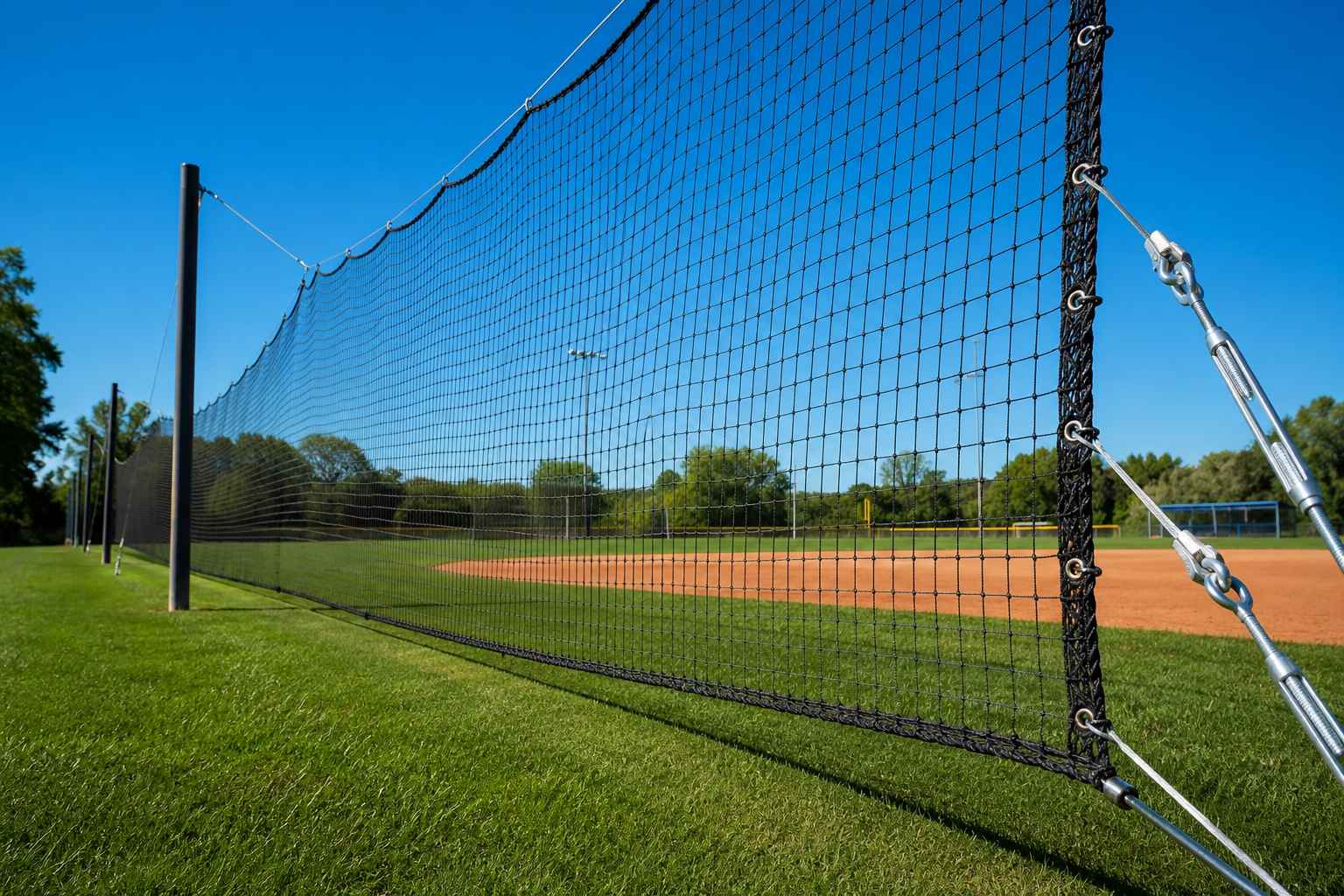
- Outdoor ball-stop and perimeter barrier netting in UV-stabilized HDPE, where low weight reduces the load on poles and cable.
- Soccer, volleyball and tennis nets.
- Bird, anti-hail and crop netting, which are knitted.
- Landing nets, where a knotless or rubber-coated bag protects the fish.
Cost and service life
For the same material and mesh strength, knotless netting is usually the cheaper net per square meter because it uses less twine. Service life depends more on the material, the UV stabilizer and the twine size than on the construction. A heavy knotted nylon cage net and a UV-stabilized knotless HDPE barrier net can both last for many seasons in the job each was designed for.
- Is the load a repeated hard impact, or wind and occasional contact?
- Does the net touch fish, skin or a finished surface?
- Will it be repaired on site by hand?
- Does weight matter — long spans on cable, large panels, sea drag?
- Does a regulation fix the mesh size?
Common questions
Is knotted or knotless netting stronger?
For the same weight of twine, knotless netting generally gives a higher mesh strength, because a knot is the weakest point of a knotted mesh. For repeated hard impact and abrasion, heavy knotted nylon remains the standard, because the knots hold the mesh size and the net is easily mended.
Which is better for a batting cage?
Knotted nylon is the usual choice for batting cages, in #21 twine for backyard use up to #42 or #60 for heavy use. Knotless HDPE cage nets are lighter and weather well outdoors, and suit lighter use.
Why is knotless netting used in fish farming?
A knotless mesh is smooth, so it does less damage to the scales and skin of fish held against it. It is also lighter and has lower drag in a current than knotted netting of the same strength.
Can knotless netting be repaired?
Yes, but less neatly than knotted netting. Small holes are usually laced closed or covered with a patch of the same netting. Knotted netting can be mended mesh by mesh with twine and a netting needle.
- U.S. Fish & Wildlife Service — Net materials (fish sampling gear and maintenance)
- Klust, G. (1982). Netting Materials for Fishing Gear. FAO Fishing Manuals, 2nd edition.