Industrial · 3 min read · Updated
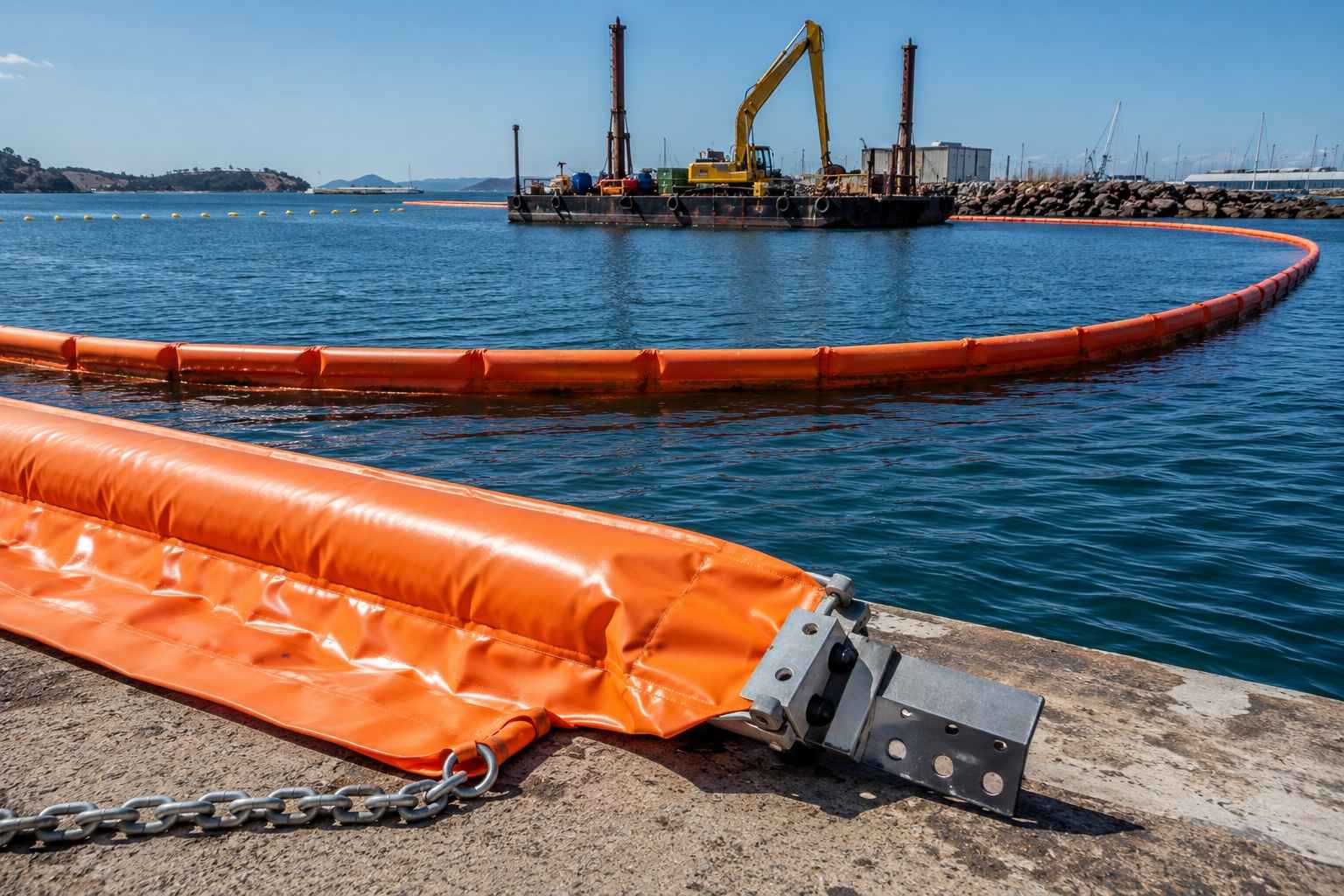
A turbidity curtain — also called a silt curtain or turbidity barrier — is a floating fabric barrier that holds disturbed sediment inside a work area long enough for it to settle. It consists of flotation along the top, a fabric skirt hanging below, and ballast chain along the bottom.
Curtains are classed into three types by the water conditions they must survive. Agencies word the definitions slightly differently, so the project specification always governs; the classes below follow the wording used in widely adopted state erosion-control standards.
The three types
Type is set by current, wind and waves at the site — not by the depth of the water.
| Type | Site conditions | Typical sites | Typical construction |
|---|---|---|---|
| Type 1 | Protected water with no current and little wind or wave action | Ponds, small lakes, sheltered shoreline, marina basins | Light fabric, smaller flotation, ballast chain |
| Type 2 | Moving water: small to moderate current, up to about 2 knots (3.5 ft/s), with wind and wave action | Rivers, streams, open lakes | Heavier fabric, larger flotation, top tension cable, heavier ballast chain |
| Type 3 | Considerable current, up to about 3 knots (5 ft/s), tidal action, wind and waves | Tidal rivers, harbors, coastal and intracoastal sites | Heaviest fabric, largest flotation, top and bottom load lines, often with permeable panels |
A curtain does not stop moving water. In a current it is set parallel to the flow to guide water around the work area, never across a channel. Above about 5 ft/s a curtain is generally not effective, and other controls are needed.
How a curtain is built
The components scale up from Type 1 to Type 3.
- Flotation — closed-cell foam sealed in the top of the curtain. Larger floats give the freeboard needed in waves.
- Skirt fabric — impermeable PVC-coated polyester, or a permeable filter fabric that lets water through while holding sediment. Permeable panels reduce the load on a curtain in current and tide.
- Ballast — galvanized chain sealed in a pocket along the bottom to keep the skirt vertical.
- Tension member — the ballast chain alone in Type 1; a steel cable along the top, or top and bottom, in Types 2 and 3 carries the pull of the current.
- Connectors — sections, commonly 50 ft or 100 ft long, join end to end with laced, bolted or slide connectors.
- Anchoring — anchors and marker buoys at intervals along the curtain, on both sides where the flow reverses with the tide.
How deep should the skirt be
The skirt should not reach the bottom. A curtain resting on the bed is dragged, abraded and buried, and it stirs up the sediment it is meant to contain. The common rule is to leave about 1 ft of clearance above the bottom at the lowest expected water level.
In moving and tidal water, depth is limited further. A deep skirt presents a large area to the current, so many specifications cap the skirt at about 10–12 ft in flowing water even where the water is deeper. Sediment settles below the skirt as the water slows.
Installation points that decide performance
Most failures come from installation, not from the fabric.
- Set every anchor point before the curtain goes into moving water, and anchor both sides where the flow reverses with the tide.
- Attach anchor lines to the flotation, not to the bottom of the curtain.
- Leave slack in the anchor lines at tidal sites, so that the curtain rises and falls freely.
- Keep the skirt furled until the curtain is in position, then release it.
- Let the sediment settle before the curtain comes out, and remove it in a way that stirs up as little as possible.
- Type required by the specification, or the site's current, tidal range and wave exposure
- Skirt depth, from the water depth at low water less the bottom clearance
- Total length and section length
- Fabric: impermeable or permeable, weight and color
- Flotation size, ballast chain size and tension cable
- Connector type between sections
- Anchor kits, marker buoys and lights where navigation rules require them
Common questions
What is the difference between Type 1, Type 2 and Type 3 turbidity curtains?
Type 1 is for protected water with no current. Type 2 is for moving water with small to moderate current, up to about 2 knots, and wind and waves. Type 3 is for considerable current up to about 3 knots, tidal action, wind and waves. Each step uses heavier fabric, larger flotation and stronger load lines.
Is a silt curtain the same as a turbidity curtain?
Yes. Turbidity curtain, turbidity barrier, silt curtain and floating silt barrier are names for the same product. "Turbidity curtain" is more common in the United States; "silt curtain" in Australia, Europe and Asia.
How deep should a turbidity curtain be?
Deep enough to enclose the disturbed water but not to touch the bottom. Leave about 1 ft of clearance above the bed at low water. In moving or tidal water, many specifications limit the skirt to about 10–12 ft.
Can a turbidity curtain be installed across a river?
No. A curtain is not a dam and should not be placed across a flowing channel. It is set parallel to the flow, around the work area, so that water passes alongside it.
What is a permeable turbidity curtain?
A curtain whose skirt, or panels within it, is made of filter fabric that lets water pass while holding back sediment. It reduces the force of current and tide on the curtain, which is why it is common in Type 3 curtains.
- Delaware Erosion and Sediment Control Handbook — Standard Detail & Specifications DE-ESC-3.5.3: Turbidity Curtain
- Virginia Erosion and Sediment Control Handbook (1992) — Standard and Specification 3.27: Turbidity Curtain
- Francingues, N.R. and Palermo, M.R. (2005). Silt curtains as a dredging project management practice. ERDC TN-DOER-E21, U.S. Army Engineer Research and Development Center.