Fishing · 8 min read · Updated
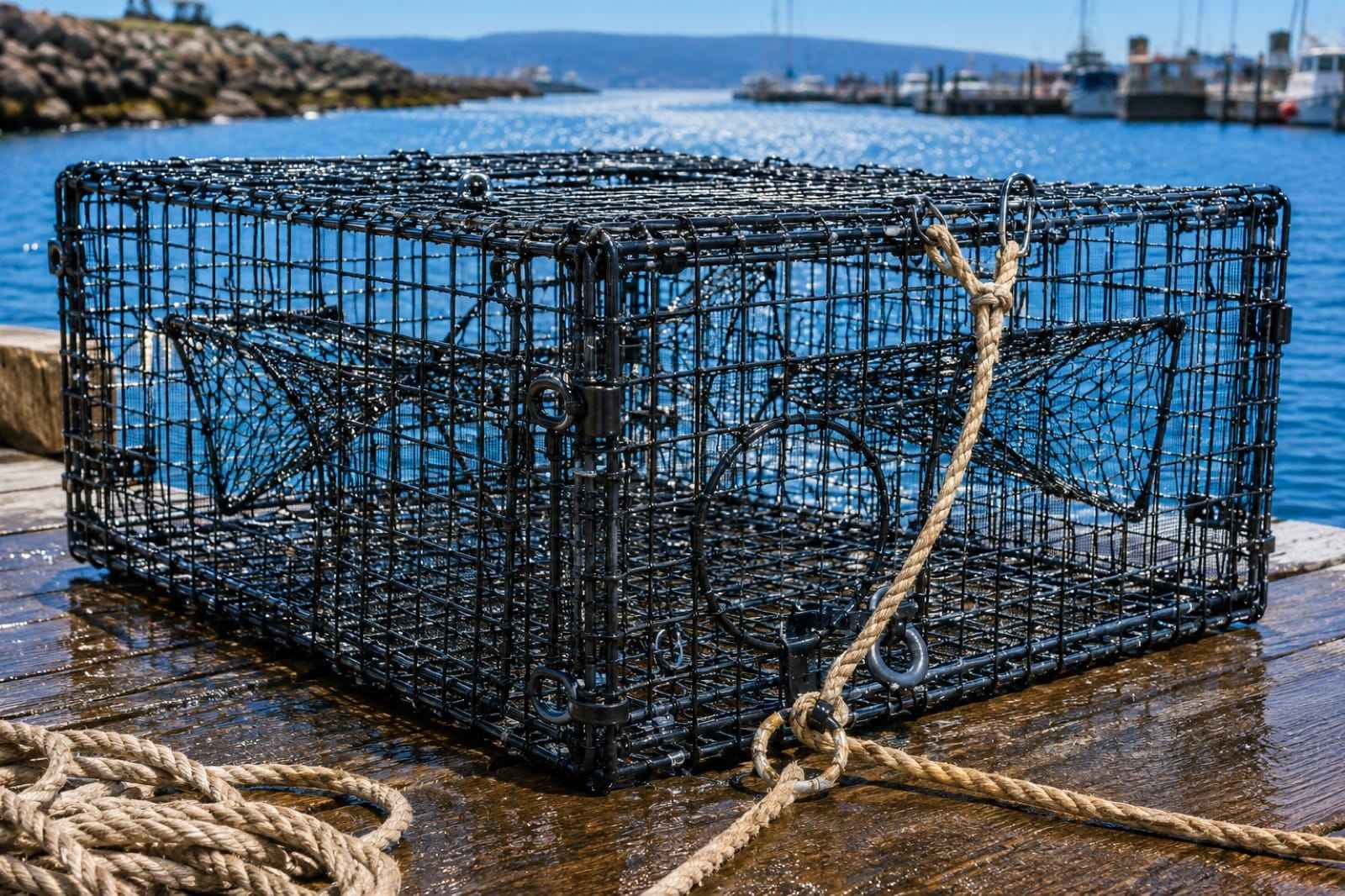
Crab pot construction is regulated state by state, and the rules reach into the pot itself: how many escape rings it has and how large they are, whether a panel must rot open if the pot is lost, whether the funnel needs a turtle excluder, and what the buoy looks like. A pot built for Florida does not meet the Maryland rule, and neither meets Washington's.
The tables below summarize the rules for recreational pots as each state agency published them in November 2026. They are a reference for buyers and brands specifying pots for a market — not legal advice. Regulations change, commercial rules differ, and some rules vary by area within a state. The agency's current text governs; each one is linked under References.
Dungeness crab pots: Pacific states
Recreational Dungeness pots in Washington, California and Alaska need two escape rings and a biodegradable escape mechanism — a cotton cord that rots through and opens the pot if it is lost. Oregon requires neither on recreational pots, although both are required on commercial pots there.
| State | Escape rings | Biodegradable escape mechanism | Buoy and line | Pots per person |
|---|---|---|---|---|
| Washington | 2 or more, 4-1/4 in inside diameter, in the upper half of the pot (4 in on the Columbia River) | Untreated cotton, hemp, jute or sisal cord no larger than thread size 120, securing the lid or closing an opening of at least 3 × 5 in | Buoy half red, half white, with name and permanent mailing address; line weighted so that it does not float | 2 (3 on the Columbia River); pot no larger than 13 cubic feet |
| Oregon | Not required on recreational pots | Not required on recreational pots | Buoy marked with the owner's name and one other identifier; pop-up buoys prohibited | 3 rings, lines or pots |
| California | At least 2 rigid circular openings of 4-1/4 in, the lowest point of each no more than 5 in below the top of the trap | A single strand of untreated cotton twine, size No. 120 or less, that frees an opening of at least 5 in diameter | Main buoy at least 5 × 11 in marked with the operator's GO ID number; red marker buoy 3 × 5 in within 3 ft of it | 10 traps, serviced at least every 9 days |
| Alaska (Southeast) | 2, of 4-3/8 in, on opposite sides in the upper half of the pot | An opening at least 18 in long near the bottom of a sidewall, laced with untreated cotton twine no larger than 30-thread; or a lid tie-down secured by a single loop no larger than 60-thread | Buoy marked with first initial, last name, home address, and the boat's AK number or name | 5 for residents, 4 for nonresidents; 10 per vessel |
Commercial rules are stricter and differ again. Oregon's commercial pots need two escape ports of 4-1/4 in and a cotton destruct mechanism of 120 thread or lighter. Each Pacific state also assigns its commercial Dungeness fishery a line-marking color scheme, and recreational gear may not carry those marks.
Blue crab pots: escape rings on the Atlantic and Gulf coasts
Escape rings — called cull rings in the Chesapeake states — let undersized crabs leave the pot. Most Atlantic and Gulf states set the minimum inside diameter at 2-3/8 in. The number of rings and where they sit differ in every state.
| State | Rings | Minimum inside diameter | Position |
|---|---|---|---|
| Maryland (Chesapeake Bay) | 2 | One of 2-3/16 in and one of 2-5/16 in | Exterior side panels or the top panel |
| Virginia | 2 | 2-3/8 in | One in each of two opposite exterior side panels of the upper chamber |
| North Carolina | 3 | 2-5/16 in | Two on opposite outside panels of the upper chamber; at least one within one mesh of a corner and of the divider |
| South Carolina | 2 | 2-3/8 in | On vertical surfaces, at least one in the upper chamber, within 2 in of the partition or the base |
| Georgia | 2 | 2-3/8 in | On an outside vertical wall |
| Florida | 3 | 2-3/8 in | One on a vertical outer surface next to each crab-retaining chamber |
| Louisiana | 3 | 2-3/8 in | Two in the upper chamber flush with the baffle; one in the lower chamber within one mesh of the floor |
| Texas | 2 in each crab-retaining chamber | 2-3/8 in | On the outside trap walls |
Turtle excluders in the funnel
Diamondback terrapins enter crab pots after the bait and drown. Several Atlantic states therefore require a turtle excluder — a bycatch reduction device — in each entrance funnel: a rigid rectangle that admits a crab but not a terrapin. Two sizes are in use.
| State | Where it is required | Maximum opening |
|---|---|---|
| Maryland | Every recreational pot, on each entrance funnel in the lower chamber | 1-3/4 in high × 4-3/4 in long |
| Delaware | Recreational pots, in each funnel entrance | 1.75 × 4.75 in |
| Virginia | Required under one of the state's two five-pot recreational licenses; encouraged on other pots | 1-3/4 × 4-3/4 in |
| New Jersey | Pots set in water less than 150 ft wide at mean low tide, or in any man-made lagoon | 2 in high × 6 in wide |
| Florida | Every recreational trap, since March 1, 2023 | 2 in high × 6 in wide, in each throat |
| North Carolina | Only in the state's two Diamondback Terrapin Management Areas, March 1 to October 31 | Approved designs set by proclamation |
Degradable panels: so a lost pot stops fishing
A pot that loses its buoy keeps catching — ghost fishing — until it falls apart. A degradable panel or lid tie-down limits that: the fastening rots or rusts through within months and leaves the pot open. On the Pacific coast the mechanism is the cotton cord in the first table. On the Atlantic and Gulf coasts, three of the states covered here require one on recreational pots.
Treated twine, stainless wire and coated wire defeat the purpose and do not satisfy these rules. The fastening has to be the untreated material the rule names.
- Florida — a lid tie-down secured with untreated jute twine, uncoated steel wire of 24 gauge or thinner, or an untreated pine dowel; or a sidewall opening at least 6 in high and 3 in wide, closed with one of those materials.
- Texas — a lid tie-down secured with untreated jute or sisal twine, or untreated steel wire of 20 gauge or smaller; or a sidewall opening at least 3 × 6 in, closed with the same materials.
- New Jersey — a biodegradable panel at least 6-1/2 in wide and 5 in high in the upper section of the pot.
Buoys, marking and pot limits
Buoy color is assigned by several states so that recreational gear can be told from commercial gear at a distance. Most states also require the owner's identification on the buoy or the pot.
| State | Buoy | Marking | Pots per person |
|---|---|---|---|
| Maryland | Buoy, or a pole and sign, unless the pot is tied to the owner's pier | DNR identification number (Chesapeake Bay) | 2 per waterfront property |
| Delaware | All white | Owner's full name and permanent mailing address | 2 |
| Virginia | No color specified | The letter R and the last four digits of the owner's social security or driver's license number, at least 1 in high | 2, or 5 with a license |
| North Carolina | Hot pink, on non-floating line | Owner's last name and initials, and boat registration number | 1 from a private pier or shore; 5 with a recreational gear license |
| South Carolina | Yellow, spherical, at least 6 in | Owner's name and address | 2, or 5 with an endorsement; trap no larger than 24 × 24 × 24 in |
| Georgia | Fluorescent green or lime green | Owner's name and address in 1 in letters | 6; trap no larger than 2 × 2 ft |
| Florida | At least 6 in | The letter R at least 2 in high; registration number on the trap | 5; trap no larger than 2 × 2 × 2 ft |
| Louisiana | Solid float of at least 6 in, on non-floating line | Stainless steel tag in the trap with the license number | 10 |
| Texas | White, at least 6 × 6 × 6 in, with a 2 in center stripe of a contrasting color | Gear tag, valid for 10 days | 6; trap no larger than 18 cubic feet |
What this means for a pot specification
No single pot meets every state's rule, so the destination market belongs on the purchase order. The differences are small parts — rings, a panel, an excluder, a buoy — and are settled at the specification stage.
- Ring size: 2-3/8 in meets the minimum diameter in all eight Atlantic and Gulf states in the table above; Dungeness pots take 4-1/4 in, or 4-3/8 in for Alaska. The number of rings and their position are set per state.
- Excluders: two funnel sizes cover the states listed — 1-3/4 × 4-3/4 in and 2 × 6 in.
- Escape mechanism: name the cord or wire the rule names — untreated cotton of 120 thread or lighter, 30-thread cotton, untreated jute, or uncoated steel wire of a stated gauge.
- Buoys: color and minimum size are fixed by state, and the owner adds the identification.
- Packaging claims: state which rule the pot is built to and the date, because rules change between seasons.
- State or states where the pots will be sold, and recreational or commercial use
- Escape rings: number, inside diameter and position
- Biodegradable escape mechanism: opening size and the fastening material
- Turtle excluder: funnel opening size, fitted or supplied loose
- Pot size limit: outside dimensions or volume
- Buoy color and size; line that sinks where the state requires it
- The date of the regulation the specification was checked against
Common questions
What size escape rings does a crab pot need?
It depends on the state and the species. For blue crab, Virginia, South Carolina, Georgia, Florida, Louisiana and Texas require rings of at least 2-3/8 in inside diameter; North Carolina requires 2-5/16 in; Maryland requires one ring of 2-3/16 in and one of 2-5/16 in. For Dungeness crab, Washington and California require 4-1/4 in and Alaska 4-3/8 in.
How many escape rings are required on a crab pot?
Two in Maryland, Virginia, South Carolina, Georgia, Washington, California and Alaska; three in North Carolina, Florida and Louisiana; and two in each crab-retaining chamber in Texas. Oregon does not require escape rings on recreational pots.
Which states require a turtle excluder on crab pots?
Maryland, Delaware and Florida require one on every recreational pot. Virginia requires one under one of its two five-pot recreational licenses, New Jersey on pots set in narrow waters and man-made lagoons, and North Carolina only in its two terrapin management areas. The opening is limited to 1-3/4 × 4-3/4 in or 2 × 6 in, depending on the state.
What is rot cord on a crab pot?
Rot cord is an untreated natural-fiber cord that secures the lid or an escape opening. If the pot is lost, the cord decays and the pot opens, so it stops catching. Washington and California require untreated cotton of 120 thread or lighter; Alaska specifies 30-thread cotton twine on a sidewall opening.
What color buoy is required on a recreational crab pot?
It varies by state: half red and half white in Washington, hot pink in North Carolina, yellow in South Carolina, fluorescent or lime green in Georgia, all white in Delaware, and white with a contrasting center stripe in Texas. Florida and Virginia require the letter R on the buoy.
- Washington Department of Fish & Wildlife — Statewide gear rules (WAC 220-330-020)
- Oregon Department of Fish & Wildlife — Oregon shellfish regulations
- California Department of Fish and Wildlife — Crab sport fishing regulations (14 CCR 29.80)
- Alaska Department of Fish and Game — Southeast Alaska shellfish regulations, 2026
- Maryland — COMAR 08.02.03.07 (recreational crab pots)
- Delaware — 2026 Delaware Fishing Guide: blue crabs
- Virginia Marine Resources Commission — Recreational crabbing rules
- New Jersey — 2026 Marine Digest: mollusks and crustaceans
- North Carolina Division of Marine Fisheries — Recreational crabbing guide
- South Carolina Code of Laws — Title 50, Chapter 5: Marine Resources Act
- Georgia DNR Coastal Resources Division — Shrimp, crab and shellfish regulations
- Florida Fish and Wildlife Conservation Commission — Recreational blue crab regulations (F.A.C. 68B-45.004)
- Louisiana Revised Statutes 56:332 (crab traps: escape rings and marking)
- Texas Parks & Wildlife Department — Legal devices, methods & restrictions: crab traps