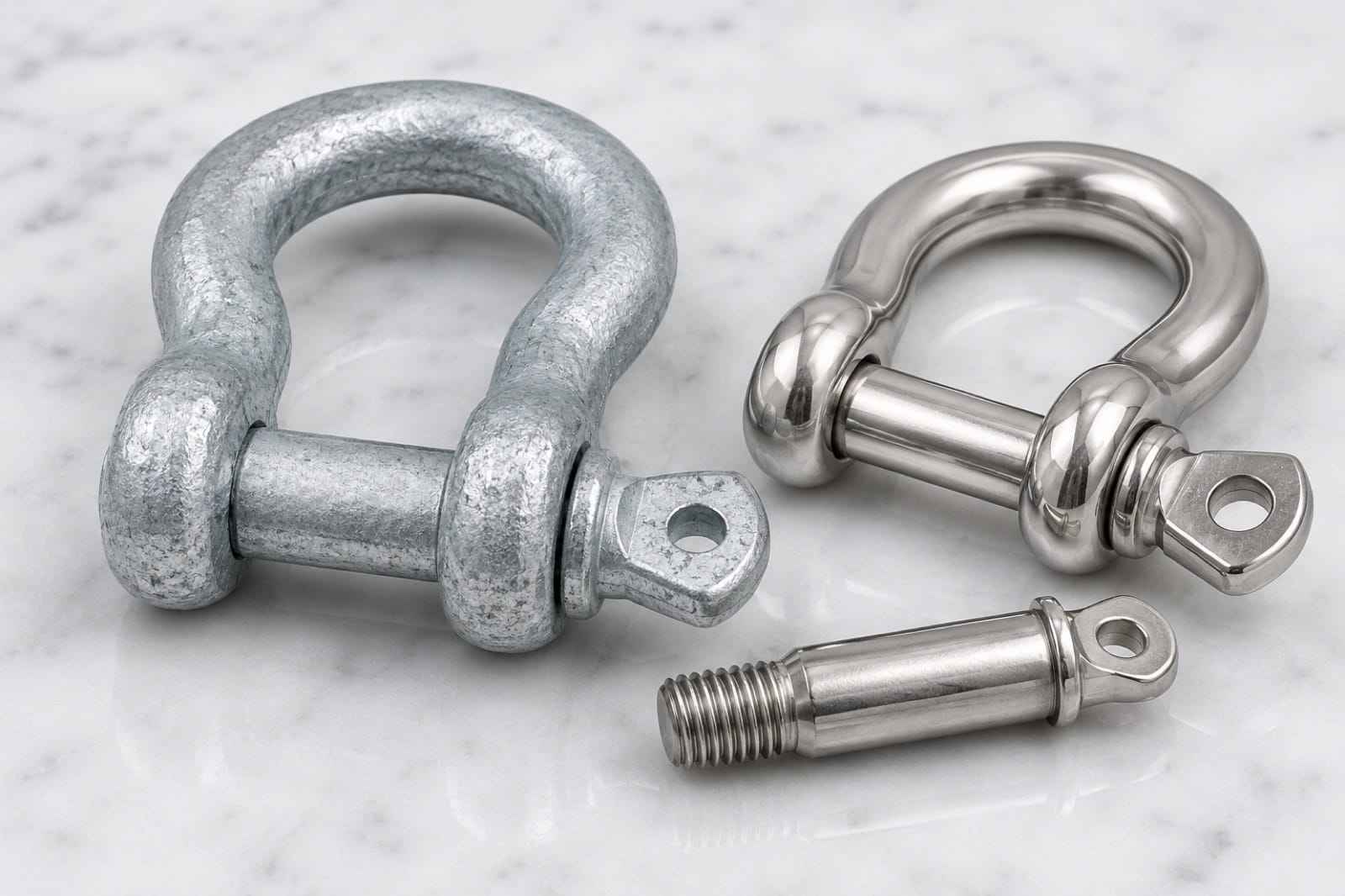
Marine · 3 min read · Updated
A shackle is sized by the diameter of its bow, not by its pin and not by its opening. The working load limit follows from that diameter and from the steel: a 1/2 in carbon steel shackle carries 2 tons, a 3/4 in shackle carries 4-3/4 tons.
The chart below gives the working load limits for forged carbon steel shackles to U.S. Federal Specification RR-C-271, the specification most galvanized shackles are made to.
Working load limit chart
Forged carbon steel anchor and chain shackles, screw pin or bolt type. Tons are short tons of 2,000 lb.
| Nominal size (bow diameter) | Nominal pin diameter | Working load limit (tons) | Working load limit (lb) |
|---|---|---|---|
| 1/4 in | 5/16 in | 1/2 | 1,000 |
| 5/16 in | 3/8 in | 3/4 | 1,500 |
| 3/8 in | 7/16 in | 1 | 2,000 |
| 7/16 in | 1/2 in | 1-1/2 | 3,000 |
| 1/2 in | 5/8 in | 2 | 4,000 |
| 5/8 in | 3/4 in | 3-1/4 | 6,500 |
| 3/4 in | 7/8 in | 4-3/4 | 9,500 |
| 7/8 in | 1 in | 6-1/2 | 13,000 |
| 1 in | 1-1/8 in | 8-1/2 | 17,000 |
| 1-1/8 in | 1-1/4 in | 9-1/2 | 19,000 |
| 1-1/4 in | 1-3/8 in | 12 | 24,000 |
| 1-3/8 in | 1-1/2 in | 13-1/2 | 27,000 |
| 1-1/2 in | 1-5/8 in | 17 | 34,000 |
The pin is one size larger than the bow, which is why a 1/2 in shackle needs a 5/8 in hole in whatever it connects to. Stainless steel shackles in grade 316 are not made to this chart: their ratings are lower and vary by maker, so read the marking.
Bow (anchor) shackle vs. D (chain) shackle
The two body shapes are the same product under different names. In North America they are anchor shackles and chain shackles; in the UK and Australia they are bow shackles and D (dee) shackles.
| Bow / anchor shackle | D / chain shackle | |
|---|---|---|
| Shape | Rounded, wider bow | Narrow, straight-sided body |
| Loading | Takes load from several directions; suits multi-leg slings | In-line loads only |
| Side loading | Permitted at a reduced rating | Avoid |
| Typical use | Anchors, mooring, sling collection points | Chain connections, straight single-leg pulls |
Pin types
The pin is chosen for how long the connection stays made.
- Screw pin — the pin threads into the shackle ear. Quick to fit and remove; for connections that are made and broken often. Tighten fully, and secure the pin with seizing wire where it is left in place, because vibration can back it out.
- Bolt type — a bolt with a nut and cotter pin. For long-term or permanent connections, and wherever the load could rotate the pin.
- Round pin — a plain pin held by a cotter. For in-line loads in tie-down and towing; not for side loads.
Side loading and proof testing
A shackle is rated for a load in line with its centerline. When a screw pin or bolt-type shackle is loaded at an angle, the working load limit is reduced.
| Angle of load from the centerline | Adjusted working load limit |
|---|---|
| 0° (in line) | 100% of rated WLL |
| 45° | 70% of rated WLL |
| 90° | 50% of rated WLL |
Under RR-C-271, shackles are proof loaded to 2.2 times their working load limit, and the minimum breaking load is five times the working load limit. Each shackle body is marked with the maker's name or trademark, the size and the working load limit. Take a shackle out of service if the marking is unreadable, the pin does not seat fully, or the body is bent, cracked or worn.
- Required working load limit, allowing for any side loading
- Body: bow (anchor) or D (chain)
- Pin: screw pin, bolt type or round pin
- Material and finish: hot-dip galvanized carbon steel, alloy steel or 316 stainless
- Pin diameter against the hole it must pass through
- Marking: size, WLL and maker on every piece
- Proof-test certificate requirement for the order
Common questions
What is the working load limit of a 1/2 inch shackle?
A 1/2 in forged carbon steel shackle to RR-C-271 has a working load limit of 2 tons (4,000 lb). Alloy steel shackles of the same size are rated higher, and stainless steel shackles lower. Always use the limit marked on the shackle.
How is a shackle size measured?
By the diameter of the bow — the curved body — not the pin. The pin is one size larger: a 1/2 in shackle has a 5/8 in pin.
What is the difference between a bow shackle and a D shackle?
A bow shackle (anchor shackle) has a rounded, wider body that accepts load from several directions and can be side loaded at a reduced rating. A D shackle (chain shackle) is narrow and straight-sided and is for in-line loads only.
Can a shackle be side loaded?
Screw pin and bolt-type shackles can be, at a reduced rating: 70% of the working load limit at 45° and 50% at 90°. Round pin shackles must not be side loaded.
Screw pin or bolt-type shackle — which should I use?
Use a screw pin shackle for connections made and broken often. Use a bolt-type shackle, with its nut and cotter pin, for long-term or permanent connections and wherever the load could turn the pin.