Fishing · 7 min read · Updated
Off-bottom culture holds single oysters in mesh containers above the seabed. The container keeps predators out, keeps the oysters out of the sediment and lets the grower control stocking density and fouling. The oysters are sold live, mainly for the half-shell market.
The gear types differ in where they sit in the water, the site they need and the handling they take. This guide compares them, then gives bag mesh sizes from seed to market size. Figures come from Sea Grant, extension and FAO-hosted publications. Practice varies by region, so treat them as starting points.
Gear types side by side
The table compares the gear used for off-bottom and suspended oyster culture. The cost column is relative only.
| Gear | Where it sits and the site it suits | Labor and handling | Fouling control | Relative capital cost |
|---|---|---|---|---|
| Floating bags | At the surface: a mesh bag with a float on each side, clipped to anchored lines. Shallow or deep water; under about 8 ft (2.4 m) there is no in-water storm plan. | Each bag is flipped in place by hand. | Flipping dries the bag. In the basic layout the oysters stay submerged. | Low |
| Rack-and-bag | Just above the bottom: bags strapped to racks about 10 in (25 cm) off the seabed. Intertidal or shallow ground reached at low water; ice and very low winter tides are limits. | One person can work it. Bags are unhooked and handled by hand. | Tidal exposure where the range allows; otherwise pressure washing. | Low |
| Adjustable long-line baskets | Mid-water: baskets clipped to a tensioned line between posts, with adjustable line height. Shallow water, about 6 ft (1.8 m) or less, where posts can be installed. | Baskets are small and easy to handle. Installing posts needs heavy equipment. | The line is lifted to the top clip so baskets and oysters air-dry, for example weekly for about 24 hours. | High |
| Floating cages | At the surface: a wire cage on two pontoons, holding four or six bags. A range of depths, with room for anchor-line scope; can be sunk for storms or ice. | Two people to flip a cage. Bags come out through a door. | The cage is flipped onto its pontoons so gear and oysters air-dry. | Medium to high |
| Bottom cages | On the bottom: a wire cage on short legs, with oysters on shelves or in bags. Intertidal ground worked at low tide, or subtidal sites where only a marker buoy shows. | Subtidal cages are lifted with a davit from a boat. | No routine air-drying under water. Cages are pressure washed. | Medium, plus lifting gear on the boat |
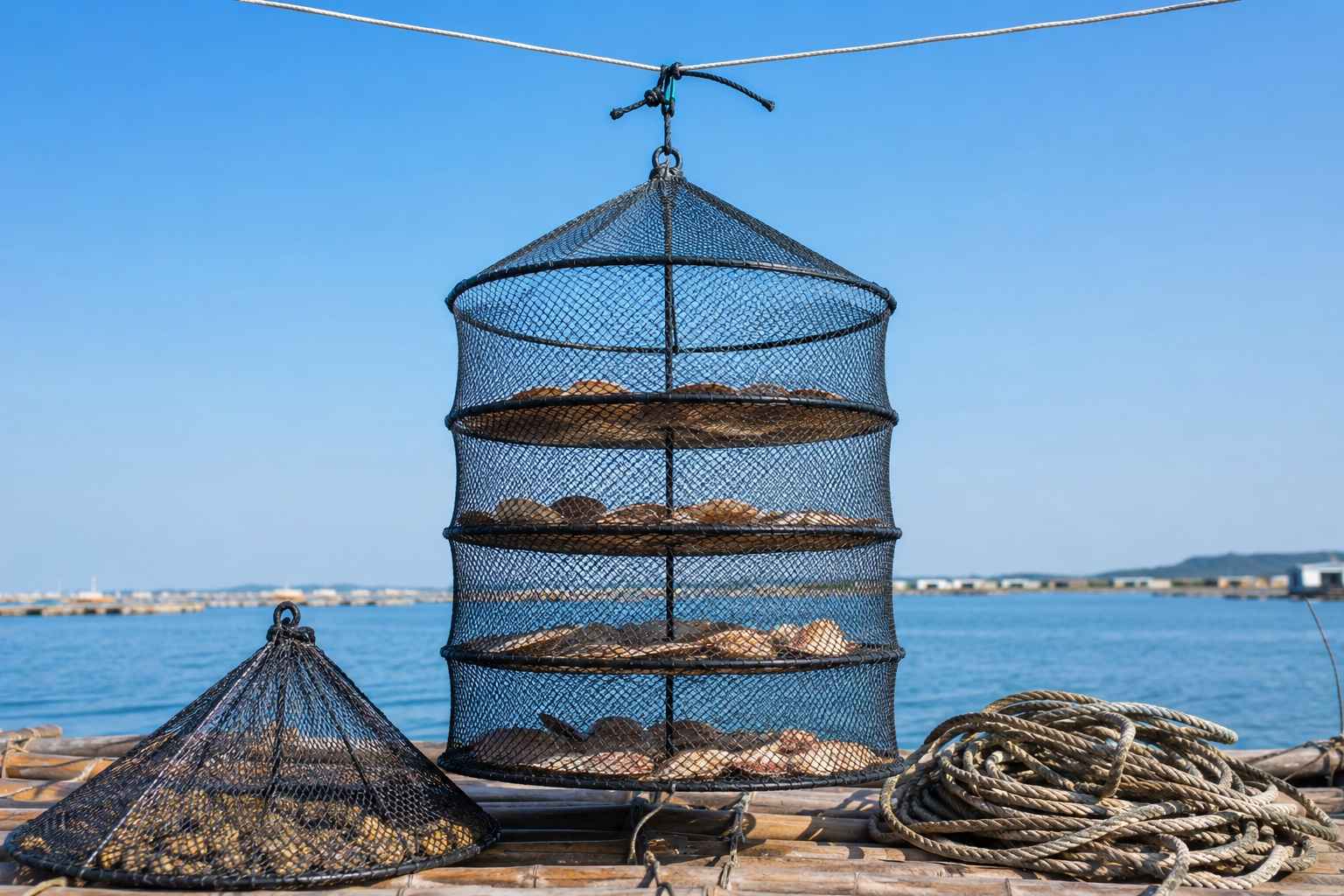
| Lantern nets | Below the surface: stacked tiers in one net, hung from a long-line. Deeper subtidal water, with depth to hang the net clear of the bottom. | Lifted to the boat to stock, thin and change. Each tier fills through a side opening. | No air-drying in place. Nets can foul heavily and are cleaned or changed. | Low for the nets; needs a long-line and a boat |
All of these systems grow single oysters for the half-shell market. Gear that moves with the waves — floating bags, and baskets hung in line with the long-line — tumbles the oysters, which shapes the shell. In a Maryland comparison, floating cages gave the most favorable shell shape and rack-and-bag gave fast shell growth. In a Massachusetts trial, bottom cages gave lower survival, growth and meat condition than floating cages.
Lantern nets and pearl nets are best known from scallop culture. A pearl net is a small pyramid or cone of 2–7 mm mesh, used mainly for spat and small seed. A lantern net is a column of tiers on wire hoops about 50 cm in diameter; an FAO-hosted review describes ten or more tiers about 15 cm high in 12 or 25 mm netting. On oyster farms, lantern nets are hung from long-lines as suspended gear.
How to choose by site
Start with the site. Water depth, tidal range, wave exposure, bottom type and storm or ice risk decide which systems can work. Labor and local permit rules decide among the rest.
Trial results do not transfer cleanly between sites. In a Massachusetts trial on five farms, floating cages gave higher survival, growth and meat condition than bottom cages overall, but not on every farm. Test new gear on a small scale first.
- Intertidal ground with a useful tidal range: rack-and-bag or bottom cages, worked at low water. The tide dries the gear.
- Shallow water, about 6 ft (1.8 m) or less: an adjustable long-line system, where posts can be installed.
- Subtidal water over a range of depths: floating bags or floating cages, with anchoring matched to fetch, wind and current.
- Sites where surface gear is restricted or not wanted: bottom cages, which show only a marker buoy, or suspended lantern nets.
- Storm or ice risk: gear that can be sunk. Floating cages are sunk by flooding the pontoons. Floating bags in water under about 8 ft (2.4 m) have no in-water storm plan.
Mesh size and stocking density from seed to market
Oysters are sieved by size and held in the largest mesh that still retains the smallest oyster in the batch. Larger mesh passes more water and food and clogs more slowly. As the oysters grow, they are moved up a mesh size and split among more bags.
The table gives the mesh sizes and stocking densities published by the Southern Regional Aquaculture Center for a polyethylene mesh bag of about 36 × 18 × 3 in (91 × 46 × 7.6 cm).
| Stage | Bag mesh (mm) | Bag mesh (in) | Suggested oysters per bag |
|---|---|---|---|
| Nursery — smallest seed | 1 | 0.04 | 50,000 |
| Nursery | 2 | 0.08 | 10,000 |
| Late nursery | 3.3 | 0.13 | 4,000 |
| Early grow-out | 6.4 | 0.25 | 1,500 |
| Grow-out | 12.7 | 0.50 | 500 |
| Final grow-out to market size | 19 | 0.75 | 250 |
Density falls at each step because larger oysters fill more of the bag, and crowded oysters share the water flowing through it. Crowding slows growth and thins the meat.
Other publications give different counts. Mississippi-Alabama Sea Grant fact sheets give a final grow-out capacity of about 150 oysters per bag and about 75 per long-line basket. The Maryland comparison kept containers about one-third full by volume. A Massachusetts trial put 6 mm seed into 4 mm mesh bags, planned at 500 per bag, and thinned to 150–200 per bag the next spring. Practice varies by region and gear.
Growth to a harvest size of 3 in (75 mm) can take 12 to 36 months.
Biofouling and predator control
Barnacles, mussels, bryozoans and algae settle on gear and shells. Biofouling blocks the mesh, reduces the flow of food and adds weight. Mud worms bore into the shell and lower the value of a half-shell oyster. The main control is air-drying: gear is raised or flipped long enough to kill newly settled fouling but not the oysters.
Predators are controlled mainly by the container. Single oysters are at great risk if they are not protected in bags; crabs, oyster drills and flatworms take unprotected seed.
- Air-drying interval — about 24 hours each week is the routine in the Mississippi-Alabama fact sheets and the Maryland comparison. An older regional fact sheet suggests several hours. Practice varies by region and season.
- Trade-off — in the Maryland comparison the air-dried gear had the fewest mud worms, but its authors suggest drying may have slowed shell growth.
- Gear that cannot be dried in place — bottom cages are pressure washed; lantern nets are cleaned or changed.
- Tumbling — a rotating grader chips new shell growth and removes some fouling. The Maryland farm tumbled its oysters every six weeks from April to November.
- Bottom predators — gear on the bottom stays within reach of oyster drills. Floating and suspended gear holds the crop away from them.
- Crabs — small crabs enter through the mesh and grow inside. Remove them when the oysters are sorted.
Materials and service life
Bags are made of extruded polyethylene (HDPE) mesh, and long-line baskets are molded plastic. For gear that floats or is air-dried in the sun, ask the supplier to confirm that the resin is UV-stabilized. Floating and bottom cages are heavy-gauge vinyl-coated wire mesh. Lantern nets use monofilament netting on plastic-coated or galvanized wire hoops.
The Mississippi-Alabama fact sheets depreciate floating bags over four years and other gear over five. The FAO-hosted review gives lantern nets four to five years. Lines, clips and anchors carry the wave load, so reduce chafe points and inspect lines regularly.
- Water depth at low tide, tidal range, wave exposure and bottom type
- Whether floating gear is permitted on the lease
- Storm and ice plan: can the gear be sunk?
- Fouling control: flipping, lifting or pressure washing
- Seed size on arrival — it sets the smallest mesh
- Mesh size for each stage, and bag or basket count after each split
- UV-stabilized polyethylene mesh; wire gauge, mesh and coating for cages
Common questions
What is the difference between floating bags and floating cages for oysters?
A floating bag is a single mesh bag with a float on each side. A floating cage is a wire cage on two pontoons that holds four or six bags. Flipping a bag dries the bag only. Flipping a cage lifts the gear and the oysters out of the water. Cages need two people to flip, but they can be sunk ahead of a storm.
What mesh size do oyster grow-out bags use?
The mesh is stepped up as the oysters grow. One regional extension fact sheet lists bag meshes of 1, 2, 3.3, 6.4, 12.7 and 19 mm, from the smallest seed to the final grow-out stage. The mesh must always be smaller than the smallest oyster in the bag.
How many oysters go in a grow-out bag?
It depends on oyster size and the site. Published figures for a standard bag run from 10,000 or more small seed down to about 150–250 oysters at the final stage. A long-line basket holds about 75. Density is reduced each time the oysters are sorted.
How often should oyster gear be air-dried?
About 24 hours each week is the routine in Gulf Coast and Maryland extension work; the Maryland farm paused it in winter. Older guidance suggests several hours. Drying reduces fouling and mud worms but can slow growth, so the interval is set by season and site.
What are lantern nets used for?
Lantern nets are tiered nets hung from a long-line or raft. They are standard gear for growing scallops, with pearl nets used for the spat stage, and they are also used as suspended gear for oysters. They cannot be air-dried in place, so fouled nets are cleaned or changed.
- Southern Regional Aquaculture Center — SRAC Publication No. 432, Cultivating the Eastern Oyster: bag mesh sizes and stocking densities
- Mississippi-Alabama Sea Grant & Alabama Cooperative Extension — Gulf Coast Off-Bottom Oyster Farming Gear Types (floating bags, floating cages, adjustable long-line system, bottom cages)
- Maryland Sea Grant & University of Maryland Extension — Oyster Production Equipment Comparisons 2016–2018
- Woods Hole Sea Grant & Cape Cod Cooperative Extension — A Comparison of Bottom and Floating Gear for Growing American Oysters in Southeastern Massachusetts
- FAO document repository — Status of scallop farming: a review of techniques (pearl nets and lantern nets)