Fishing · 7 min read · Updated
A cast net is specified by three numbers: the radius, the mesh size and the lead weight per foot. The radius sets the area the net covers. The mesh sets which bait the net holds without gilling it. Mesh and lead together set how fast the net sinks.
The charts below give the usual choice for each, in the terms the US market uses: radius in feet, mesh in square (bar) measure and lead in pounds per foot of radius. These are typical trade figures, not a standard. Where published recommendations differ, the chart gives a range.
Cast net size chart: 3 ft to 12 ft radius
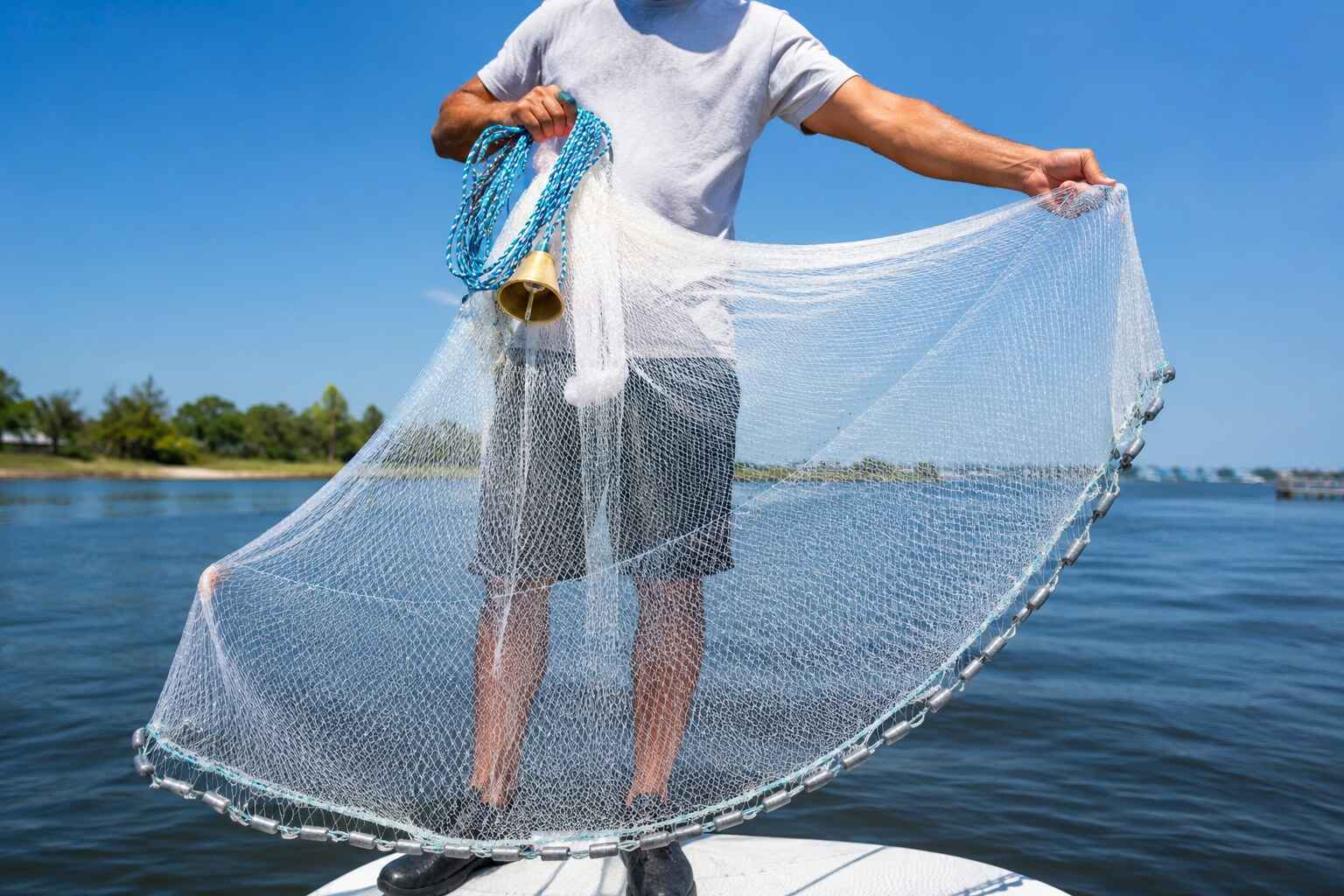
Cast net size is the radius — the length from the horn at the center to the lead line. The net opens to a circle twice that wide, so a 6 ft net covers a 12 ft circle. Most recreational nets are 8 ft or smaller. Nets of 10 ft and 12 ft are used mainly by experienced and commercial fishermen.
| Radius | Diameter when open | Area covered | Suits | Lead at 1.0–1.5 lb per ft |
|---|---|---|---|---|
| 3 ft | 6 ft | 28 sq ft | First-time users and children; creeks and very shallow water | 3–4.5 lb |
| 4 ft | 8 ft | 50 sq ft | Beginners and children; wading and kayaks | 4–6 lb |
| 5 ft | 10 ft | 79 sq ft | Beginners; wading, docks and piers | 5–7.5 lb |
| 6 ft | 12 ft | 113 sq ft | Beginners to intermediate; a common general-purpose size for shore, pier and boat | 6–9 lb |
| 7 ft | 14 ft | 154 sq ft | Intermediate; wading or boat | 7–10.5 lb |
| 8 ft | 16 ft | 201 sq ft | Intermediate to experienced; boat; the upper limit usually given for wading | 8–12 lb |
| 10 ft | 20 ft | 314 sq ft | Experienced; boat; live bait in quantity and mullet | 10–15 lb |
| 12 ft | 24 ft | 452 sq ft | Experienced and commercial; boat; large mullet | 12–18 lb |
Advice on a first net varies: a Georgia state agency guide suggests about 3 to 5 ft, and some guides start at 6 to 8 ft. A net the thrower can open fully covers more water than a larger net thrown badly.
Cast net mesh size chart by bait
US cast net mesh is quoted in square measure, also called bar measure: the length of one side of a mesh. Stretched measure is twice that figure, so a 3/8 in square mesh is a 3/4 in stretched mesh.
The working rule is to use the largest mesh that will not gill the bait. Larger mesh sinks faster. Mesh that is too large lets the bait push its head through and catch by the gills, which damages or kills it.
| Mesh (square) | Stretched | Bait or target | Trade-off |
|---|---|---|---|
| 3/16 in | 3/8 in | Minnows and small shrimp; bait of about 1–3 in | Holds the smallest bait; sinks slowest, so used in shallow water |
| 1/4 in | 1/2 in | Bait of 2–3 in: pilchards, silversides, mud minnows, small shrimp | Little gilling; sinks slowly and suits shallow water |
| 3/8 in | 3/4 in | Bait of 3–4 in: finger mullet, small menhaden, threadfin herring, sardines, shad, larger shrimp | Most common general-purpose size; can gill bait under about 3 in |
| 1/2 in | 1 in | Bait of 4–5 in and larger: menhaden, shad, alewives, mullet | Sinks faster than 3/8 in; gills small bait |
| 5/8 in | 1-1/4 in | Bait of 5 in and longer: large shad and menhaden | Fast sink for deep water and current; small bait passes through or gills |
| 1 in | 2 in | Mullet and other large bait | Sinks fast with less lead; holds only large fish |
| 1-1/4 to 1-1/2 in | 2-1/2 to 3 in | Large mullet | Fastest sink; made in heavier monofilament |
Published depth guidance keeps 1/4 in mesh to water shallower than about 5 to 8 ft, 3/8 in to about 12 ft and 1/2 in to about 20 ft. Sources do not agree on these depths, and lead weight and current change them.
How radius and mesh work together
A cast net catches only what is still under it when the lead line reaches the bottom. How fast it gets there — the sink rate — depends on the mesh, the lead and the radius.
Small mesh puts more twine in the water, so it meets more resistance and sinks more slowly than large mesh carrying the same lead. Every net also closes slightly as it falls. In deep water a slow net has narrowed before it lands, and the bait swims out from under it.
- Shallow water, under about 8 ft: sink rate matters least. A 1/4 in or 3/8 in mesh with 0.75 to 1 lb of lead per foot is enough.
- Deeper water or current: use the largest mesh the bait allows and 1.25 to 1.5 lb of lead per foot.
- A larger radius helps at depth, because the net carries more lead in total: 12 lb on an 8 ft net at 1.5 lb per foot, against 6 lb on a 6 ft net at 1 lb per foot.
- For deep water — about 30 ft or more — some nets are made with a band of tape or webbing above the lead line, which holds the net open as it sinks.
Materials: monofilament vs. nylon multifilament, lead vs. lead-free weights
Most cast nets are now nylon monofilament. It is clear, does not take up water the way twisted nylon does, and sinks quickly. Its weak points are abrasion and sunlight: it tears on oyster shell and rock, and sunlight degrades it over time.
Nylon multifilament — twisted nylon twine — is the older material and is still sold. It is softer, and makers describe it as more durable. It is also thicker and more visible, sinks more slowly, and absorbs water, so the net gains weight in use. The slower sink rate matters little in water under about 7 ft.
Compare lead-free nets on weight per foot of radius, the same way as lead nets.
- Lead is quoted in pounds per foot of radius, normally counting the lead alone. Nets are sold at 0.75, 1.0, 1.25 and 1.5 lb per foot.
- Recommendations differ. Several guides advise at least 1.5 lb per foot for bait nets; others use 1 to 1.2 lb per foot for mullet nets in shallow water.
- Closely spaced leads seal the net on the bottom; one published guide gives about 2-1/2 in between leads on a well-made net.
- Lead-free nets use steel or iron weights, often coated. Steel is about 30% less dense than lead (7,850 against 11,340 kg/m³), so each weight is larger for the same mass.
Legal limits on cast nets
Cast net rules are set by each state, and states do not measure the net the same way. Three examples, as published by the state agencies in November 2026:
Other states have their own rules, and rules change. Check the current regulation of the state fish and wildlife agency for the water where the net will be used, and note whether its size limit is a radius or a diameter.
- Texas: a cast net may not be greater than 14 ft in diameter — a 7 ft radius — and is legal only for nongame fish and other aquatic animal life such as crabs, crayfish and shrimp.
- Florida: a stretched length of no more than 14 ft, measured from the horn to the lead line with the net gathered and pulled taut. That is the radius, so the Florida limit is twice the Texas limit.
- Georgia: no limit on length, but a minimum bar mesh of 3/8 in for a bait shrimp cast net and 5/8 in for a food shrimp cast net.
- Radius in feet, checked against the size limit where the net will be used
- Mesh size, with the word "square" (bar) or "stretched" beside it
- Netting: monofilament or nylon multifilament, and the twine diameter in millimeters
- Lead weight per foot of radius, stated as lead alone or as finished net weight
- Weight material — lead, or coated steel or iron — and the spacing of the weights
- Number and breaking strength of the brail lines; type of horn and swivel
- Hand line length and material
Common questions
What size cast net is best for a beginner?
A net of 3 to 6 ft radius. A Georgia state agency guide advises starting at about 3 to 5 ft; some guides start at 6 to 8 ft. Nets of 8 ft and larger take experience to open fully.
Is cast net size the radius or the diameter?
The radius — the length from the horn to the lead line. A 6 ft cast net opens to a 12 ft circle. Regulations are not always written the same way: Texas limits the diameter to 14 ft, which is a 7 ft radius.
What mesh size cast net is best for bait?
3/8 in square mesh is the most common general-purpose size and suits bait of about 3 to 4 in. Use 1/4 in for bait of 2 to 3 in, 1/2 in for 4 to 5 in, 5/8 in for 5 in and longer, and 1 in or larger for mullet.
Does a larger mesh sink faster?
Yes. With the same lead, a larger mesh meets less water resistance and sinks faster than a smaller mesh. The limit is gilling: bait small enough to push its head through the mesh is caught by the gills.
How much lead should a cast net have?
Between 0.75 and 1.5 lb per foot of radius. About 1 lb per foot is a light net for shallow water; 1.5 lb per foot is a heavy net for deeper water and current. An 8 ft net at 1.5 lb per foot carries 12 lb of lead.
- Texas Parks & Wildlife Department — Legal devices, methods & restrictions (cast net: 14 ft diameter limit)
- Florida Fish and Wildlife Conservation Commission — Recreational shrimping regulations (cast net: 14 ft stretched length, horn to lead line)
- Georgia Department of Natural Resources — Shrimp, crab, shellfish & bait minnow regulations (bait and food shrimp cast net mesh)
- Georgia DNR Coastal Resources Division — Recreational Cast Netting and Beach Seining (2000 brochure; net choice for beginners)