Industrial · 3 min read · Updated
Exclusion netting works by being smaller than the animal it keeps out. The smaller the mesh, the more it excludes — and the more it costs, weighs, shades the crop and resists airflow. The aim is the largest mesh that still stops the target.
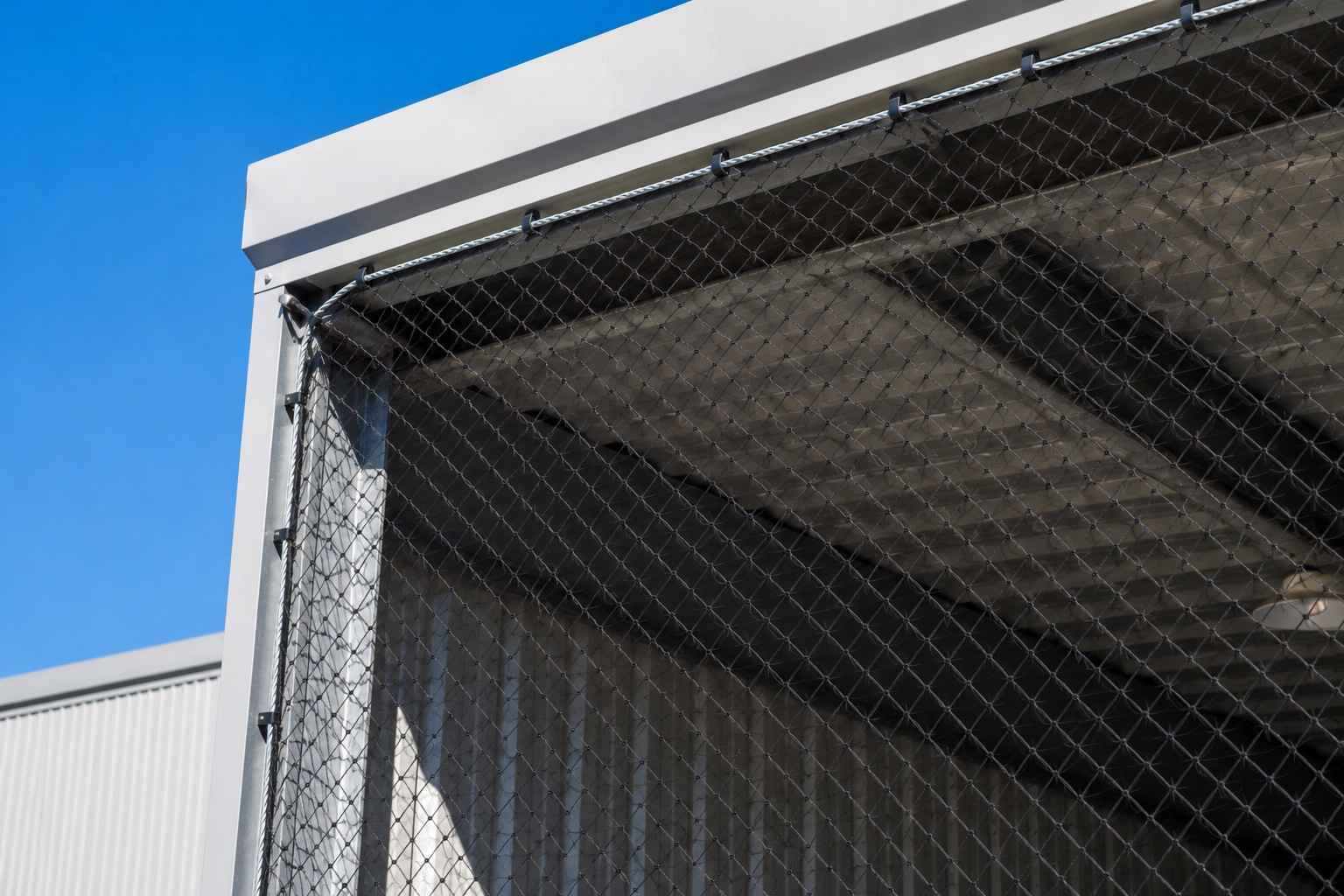
Bird netting is specified by the size of its opening in millimeters. Insect netting is specified by mesh count or by hole size. The two charts below cover each.
Bird netting mesh size by species
These four sizes are the standard for bird control on buildings and structures. A mesh sized for a small bird also excludes every larger one.
| Mesh size | Inches | Excludes | Typical sites |
|---|---|---|---|
| 19 mm | 3/4 in | Sparrows and all larger birds | Food plants, warehouses, loading bays, signage |
| 28 mm | 1-1/8 in | Starlings and all larger birds | Roof voids, plant rooms, canopies |
| 50 mm | 2 in | Pigeons and all larger birds | Building facades, light wells, bridges, solar arrays |
| 75 mm | 3 in | Gulls | Flat roofs, landfill, reservoirs |
Crop netting follows the same principle with different numbers. Netting over vineyards, cherries and berries is typically 15–20 mm to stop small fruit-eating birds. Where wildlife can become entangled, finer mesh is safer: the State of Victoria, Australia, requires household fruit netting to have a mesh of 5 mm × 5 mm or less at full stretch.
Insect netting mesh by pest
An insect screen excludes a pest when its holes are smaller than the insect's body width. The widely cited figures below come from greenhouse screening research.
| Pest | Maximum hole size | In micrometers |
|---|---|---|
| Leafminers | 0.64 mm | 640 µm |
| Silverleaf (sweetpotato) whitefly | 0.46 mm | 462 µm |
| Aphids (melon aphid) | 0.34 mm | 340 µm |
| Greenhouse whitefly | 0.29 mm | 290 µm |
| Western flower thrips | 0.19 mm | 192 µm |
Greenhouse screens are sold by mesh count. Screens of 40 and 50 mesh are the usual choice against whitefly and aphids, and thrips need a finer specialty screen. For open-field crops the meshes are coarser: netting of 1.3–1.4 mm keeps out cabbage root fly, carrot fly, moths and butterflies; 0.8 mm adds flea beetles, cabbage whitefly and aphids; and 0.3–0.6 mm is needed for thrips.
Mesh count and hole size are not the same thing
Mesh count is the number of threads per inch — a 50-mesh screen has 50 threads in each inch of the warp. The hole is what is left between the threads, so it depends on thread diameter. Two 50-mesh screens woven from different threads have different holes. Many insect screens are also rectangular, written as two counts such as 50 × 25. When the target pest is small, specify the hole size in millimeters as well as the mesh count.
The cost of a finer mesh
Every step finer reduces airflow. A greenhouse fitted with fine insect screen needs a larger screened area than its vents to keep the same ventilation, or temperatures and humidity rise. Finer netting also casts more shade and is heavier, which matters on long spans and in snow or wind. Choose the mesh for the smallest pest that actually threatens the crop, not the smallest pest that exists.
- Target species or pest — the smallest one that must be excluded
- Bird netting: mesh size in mm, twine or strand diameter, knotted or knotless, color
- Insect netting: mesh count and hole size in mm; thread diameter
- Material and UV stabilization; flame-retardant grade if required on buildings
- Roll or panel sizes; edge reinforcement
- Fixings: perimeter cable, clips, hog rings, zips for access
- For greenhouses: the vent area to be screened
Common questions
What mesh size bird netting do I need for pigeons?
50 mm (2 in) mesh. It excludes pigeons and all larger birds, and it is lighter and less visible than the finer meshes used for small birds.
What mesh size keeps sparrows out?
19 mm (3/4 in) mesh. It is the finest of the standard bird-control meshes and excludes every common pest bird.
What mesh size bird netting is used for starlings and gulls?
28 mm (1-1/8 in) for starlings and 75 mm (3 in) for gulls.
What mesh insect netting stops whitefly?
A 50-mesh screen is the usual choice. The greenhouse whitefly is excluded by holes of about 0.29 mm and the silverleaf whitefly by about 0.46 mm. Confirm the hole size, because it varies with thread diameter.
Does insect netting stop thrips?
Only a very fine screen does. Western flower thrips are excluded by holes of about 0.19 mm, finer than a standard 50-mesh screen. Thrips screens restrict airflow strongly, so the screened area has to be enlarged.
- British Pest Control Association — Bird control netting guide
- Bethke, J.A. and Paine, T.D. (1991). Screen hole size and barriers for exclusion of insect pests of glasshouse crops. Journal of Entomological Science 26(1).
- Royal Horticultural Society — Insect-proof mesh
- State of Victoria, Australia — Prevention of Cruelty to Animals Regulations 2019: household fruit netting